A final word about gingham curtains

I’m sure there are plenty of craft blogs out there and I have no intention of turning this into another one. However, at the risk of confusing everyone who arrived at this blog having Googled ‘how to fit campervan cabinets’ (and alienating everyone else) I am going to indulge in one final post about my affiliation with gingham fabric.

A few weeks ago, I bought some beautiful red gingham material, which would be perfect for the quintessential campervan curtain.  Since then, I have been looking, unsuccessfully, for some upholstery fabric to match.  The stripy fabric that Paul’s so keen to use for the seat covers would clash horribly. Plain red fabric would work well with the gingham, but next to all the red cupboards might create an ambience more ‘brothelesque’ than would be desireable.  So I have reluctantly admitted defeat. There will be no gingham in this campervan. We have bought the bright stripy fabric for the seats and I am now on the search for a plainer fabric for the curtains.

So this picture is a double-edged sword. On one hand, it means I finally managed to thread the bobbin on my new sewing machine and produce something resembling a tissue case. Hurrah! On the other hand, it means that my beautiful gingham, which had so much potential, is destined to spend the remainder of its days protecting packs of Kleenex.

So put your orders in now while my bobbin is still in place. I have samples of gingham fabric in red, lilac, navy, black and lime green. How I ever thought lime green curtains would match red cupboards, I’m not sure.
Another day, another trip to Bunnings

This morning, like most Sunday mornings this year, started with a trip to Bunnings. Indeed, Paul even leapt out of bed saying, ‘Got to get up, got to get to Bunnings’, with the sort of enthusiasm usually reserved for those days when you’re hoping to find an overflowing stocking at the end of your bed.

For people reading this blog overseas, Bunnings Warehouse is a chain of massive DIY stores. They have a sausage sizzle at the entrance and a cheery lady in an apron who welcomes you in. Paul visits at least twice every weekend. And not just because he doesn’t get fed at home (he doesn’t always have a sausage) but because he usually gets sidetracked and forgets something, so has to go back.

Although I probably don’t approach a trip to Bunnings with quite the same vigour, I still tag along every couple of weeks. Last time I spent the time wandering the length of the aisles trying to work out how many products they must stock. A serendipitous visit to their website later revealed the answer – it’s over 45,000. So there you go – it’s very big, and if you’re into DIY, it sells absolutely everything you could want. I am not into DIY, and still usually end up with an armful of treasures I didn’t realise I needed.  The trouble is, Bunnings uses the same technique as Ikea and places all the intriguing and bargainous bits at the end of the aisles. You know this is a cunning marketing trick. You know that you don’t really need another miniature torch for your handbag or any more self-cleaning eco mops, but somehow, they find their way into your basket.

Anyway, there was a point to this post, which is that so far, we have bought almost everything we’ve needed for the campervan from Bunnings. Along with three torches, this has included:

All the cabinets

Laminate flooring and insulation

Bathroom sink

Waste water and fresh water tanks

Panels for bathroom walls (sold as pantry doors)

3,000 jigsaw blades

Initially we thought we’d have to get most bits from independent suppliers and caravan stockists, but they’ve been much cheaper and more readily available from Bunnings. We’ll still have to buy the specific electrical parts from a camping store, as well as things like the water heater, but if anyone is approaching a similar project, try a DIY store first before spending a fortune at other places.

Having spent the morning extolling the virtues of Bunnings, I think I will email them now in case they would like to sponsor my site.

Campervan layout – a feat of architectural design?

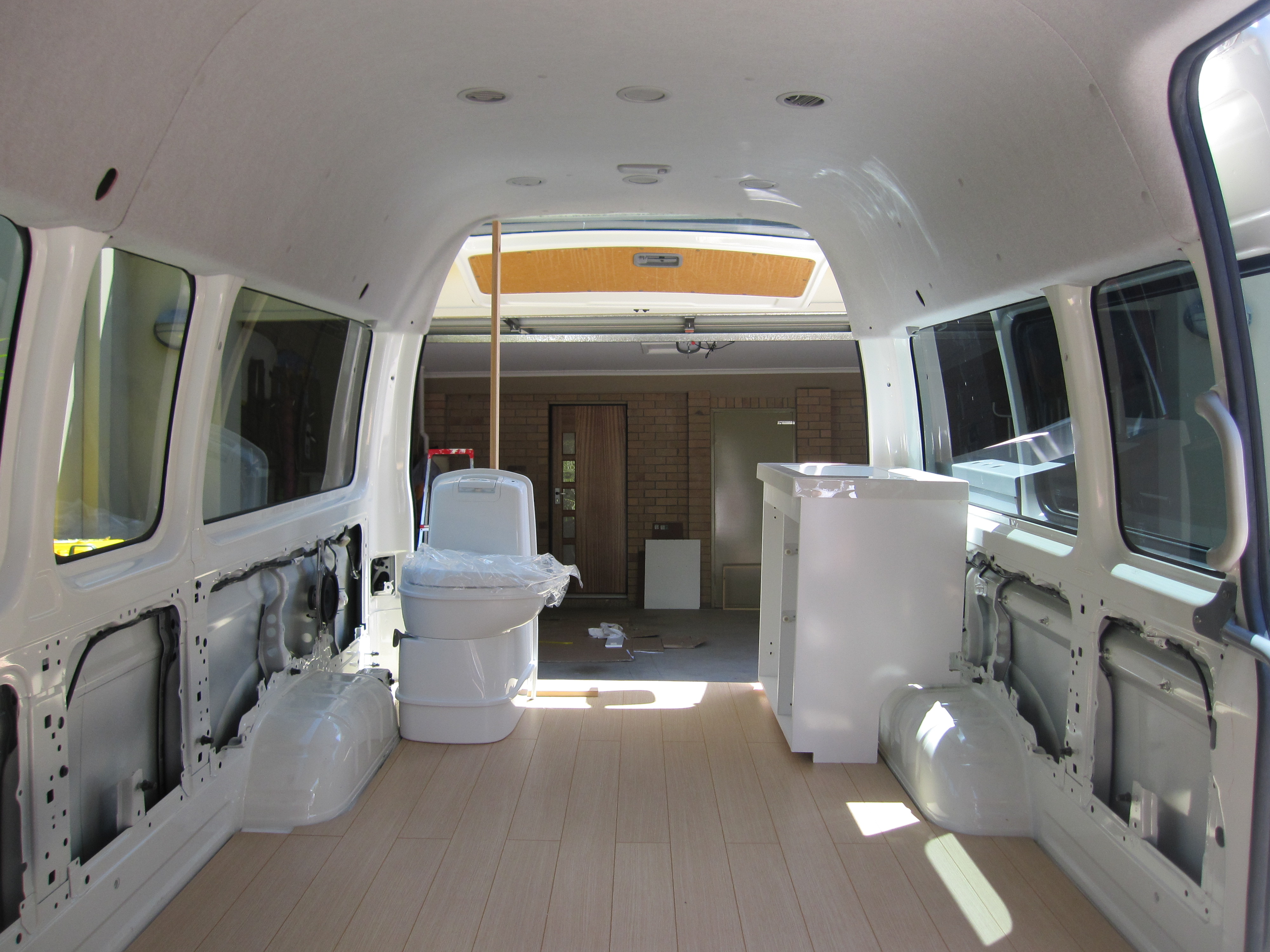
Before we started work on the van and it was still an empty shell, it was hard to imagine we’d be able to squeeze in a kitchen, bathroom and living room without it all looking very cramped. Yet somehow, now the furniture is in and the walls are up, it’s like our little minibus was always destined to be a cosy campervan. Everything just fits. It is compact and bijou! Clearly all those Thursday nights we’ve spent watching seven series of Grand Designs have been worth it – Kevin would be proud! (Actually, Kevin would say it could have been even better if we’d employed an architect, but never mind.)


The internal structure is quite defined now, and the walls have gone up between the bathroom and kitchen. Paul bought these as pantry doors and used a cardboard template to cut them to shape around the side of the van. The bathroom door will be a bit trickier. Ideally we’d want a rectangular panel that slides across the gap, but the position of the wheel arches on either side means it could only open half way. So the options are to fit a double door that opens into the bathroom, or hang a few strings of beads. That one’s still on the drawing board.


The toilet and bathroom basin are now bolted down, and the back of the toilet is fixed to another panel to facilitate the rear-entry swivel benefits, as shown below.


The seating is coming along, and the next stage will be to construct and fit an extra horizontal panel that will hinge out to form a bed. This has been a more contentious issue than you would probably imagine, and the subject of many robust discussions between Paul and his various campervan advisers. Whichever method he chooses, it’ll be one of the next jobs.

A lot of the work coming up will be less visible and includes the wiring and electrics. My sewing machine has now arrived and I may attempt another place mat before launching into the cushions. Thank you to everyone who has expressed a preference for a particular fabric. Surprisingly, almost everyone chose the same one.

(I suspect a conspiracy.)


Campervan kitchen – in go the cabinets

We’ve had to bring in reinforcements; Paul’s parents, Jean & John, were staying last week and earned their keep by knocking a few cabinets together. J & J are also keen campervanners and have just embarked on their second tour of NZ in a v posh 4-berth campervan.

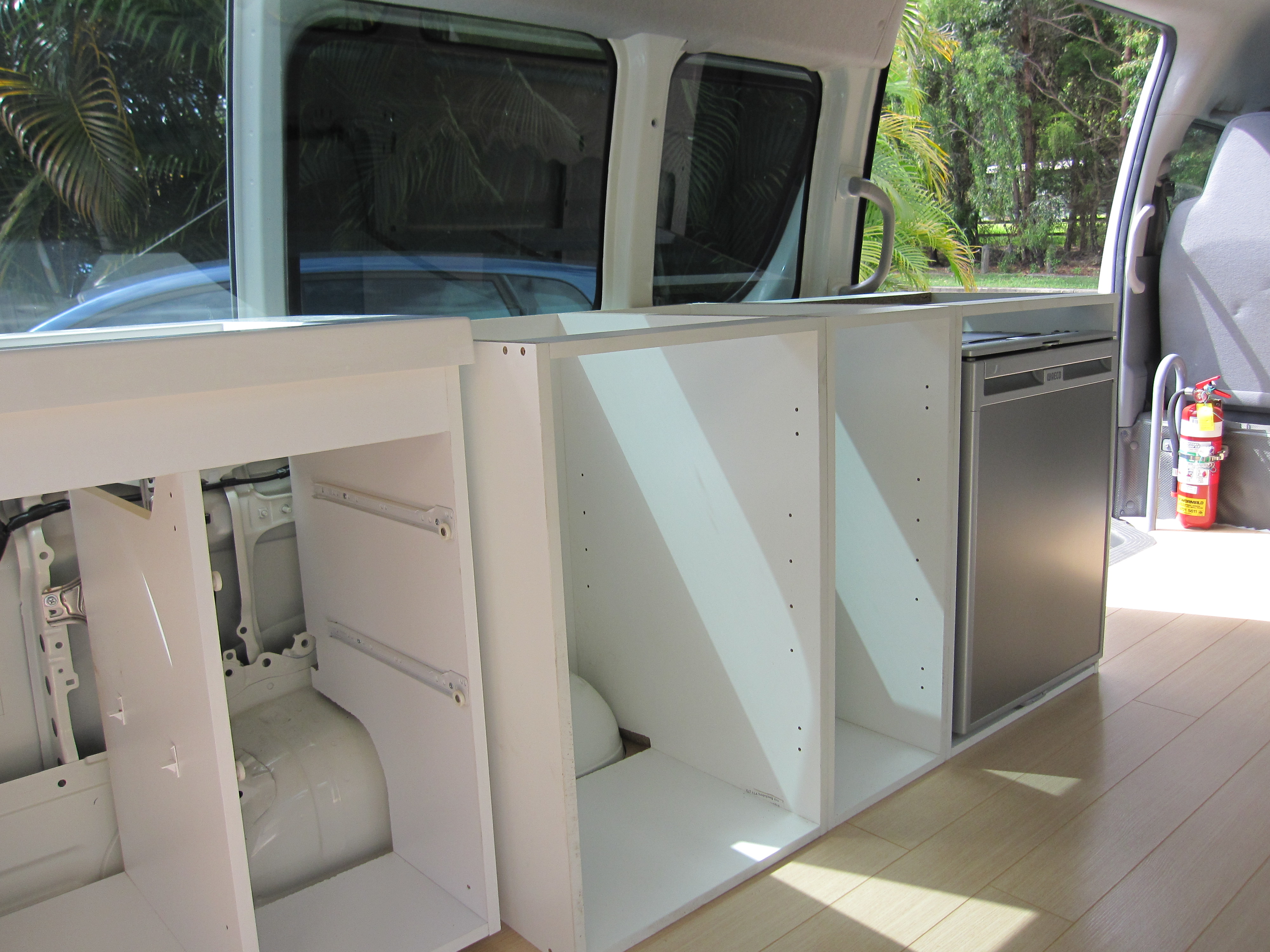
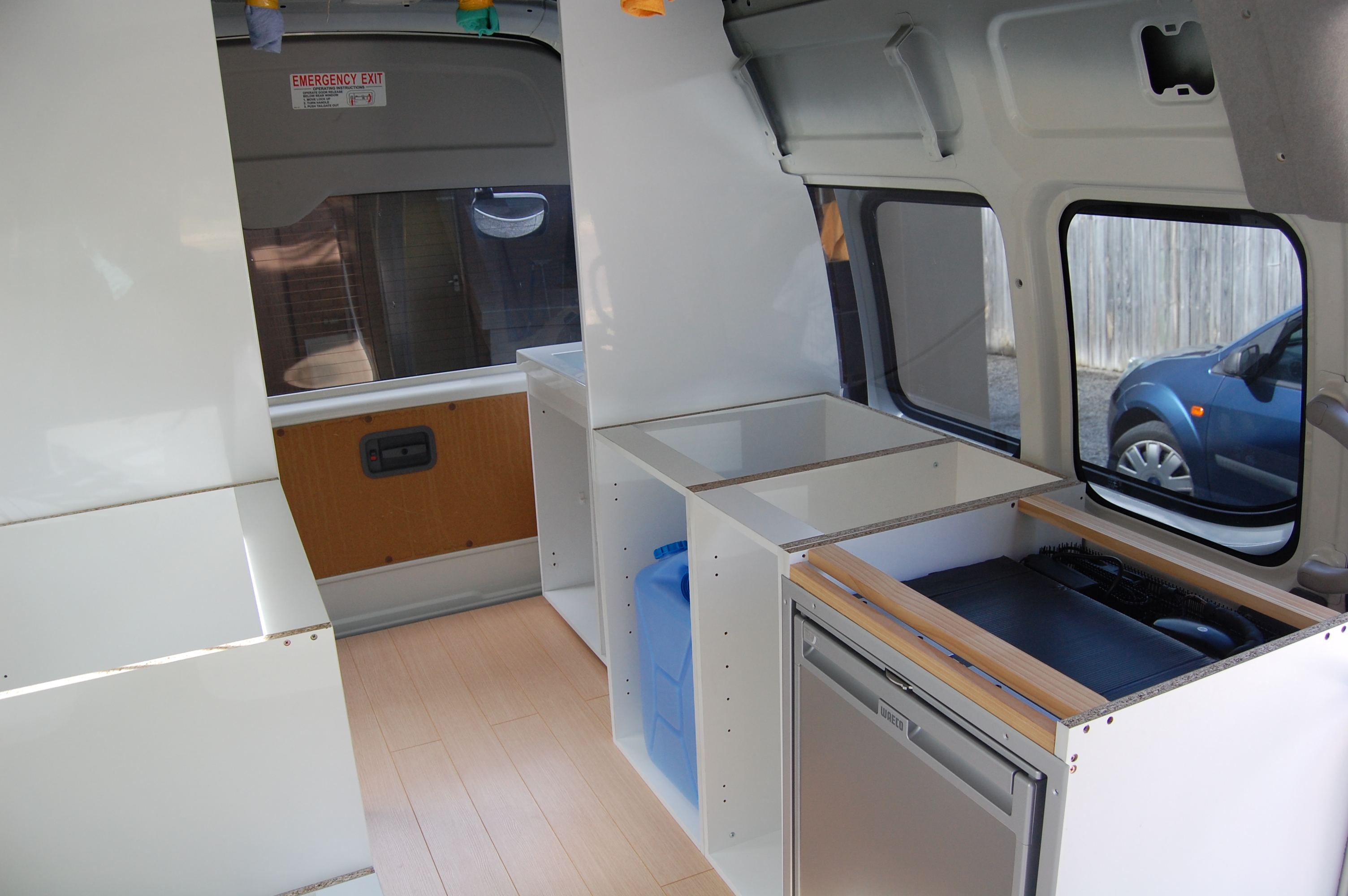
So the task last weekend was to build and fit the kitchen cabinets that will house the sink, gas stove and fridge. The ‘build’ part was made easier by buying ready-built cabinets from Bunnings! Well, they were flat-packed but still easier than just buying a load of wood. Amazingly they fit perfectly width-ways, so Paul just had to take some of the height off the bottom, and cut round all the wheel arches etc at the back.

So from left to right is the bathroom basin, then there’ll be a wall, then the kitchen sink, then the fridge.

The cabinet on the other side is for the gas stove and grill.

The fridge is a Waeco CoolMatic (80 litres), which is bigger than we thought we could fit in, and has a little ice box at the top for our frozen peas. It’ll be wired in with 6mm cables to the 12volt battery and should last about 3 days before the battery needs to be recharged. That should be plenty long enough, as I can’t imagine we’ll ever go that long without plugging into power somewhere – not intentionally anyway, and if the worst comes to the worst, we’ll just have to have a couple of meals of warm beer and defrosted peas.

The next job is to source and fit the two water tanks underneath the bathroom and kitchen sinks. Paul thinks he might be able to get them from a 4WD shop this week. He also wants to figure out the seating / bed combo; this has already prompted many colourful conversations between him and his Dad, as they both have very different ideas about how to build it. I think Paul is going to take advantage of J & J being in NZ for the next few weeks to make a start on it.

Thetford cassette toilet C200, swivel, flush tank, rear entry

This is the (slightly disconcerting) description of our campervan toilet.  I have been assured, though, that the rear is actually the best place for an entry point, and just refers to how you access the waste tank. Phew. And the swivel aspect means we can position the toilet with the rear facing towards the back door (for optimum cassette removal), but swivel the seat round so we don’t have to sit facing the wall.

As the photos below probably do a better job of explaining.

The toilet is freestanding at the moment, but will be secured to the wall that separates the bathroom from the kitchen.

And we have got the crème de la crème of campervan basins! It is twice the size of the basins in our house, and plenty big enough to have a personal wash twice a day. (Sorry, these Gavin & Stacey references just keep rolling off my tongue – anyone would think I was obsessed.)

Paul bought the bathroom cabinet and basin from Bunnings, and just had to saw 10cm off the bottom of the cupboard, and cut around the wheel arch and a couple of other protruding objects. I say ‘just’ – this was in 35 degree heat yesterday. The cabinet still needs to be bolted onto the floor, but we need to fit the waste-water tank underneath the basin first.

The next job is to fit the dividing walls, so we can start fixing things into place. Having tried out almost every conceivable colour for the walls, I think they’re going to be white.

Operation flooring – how to fit a laminate floor in a tiny campervan

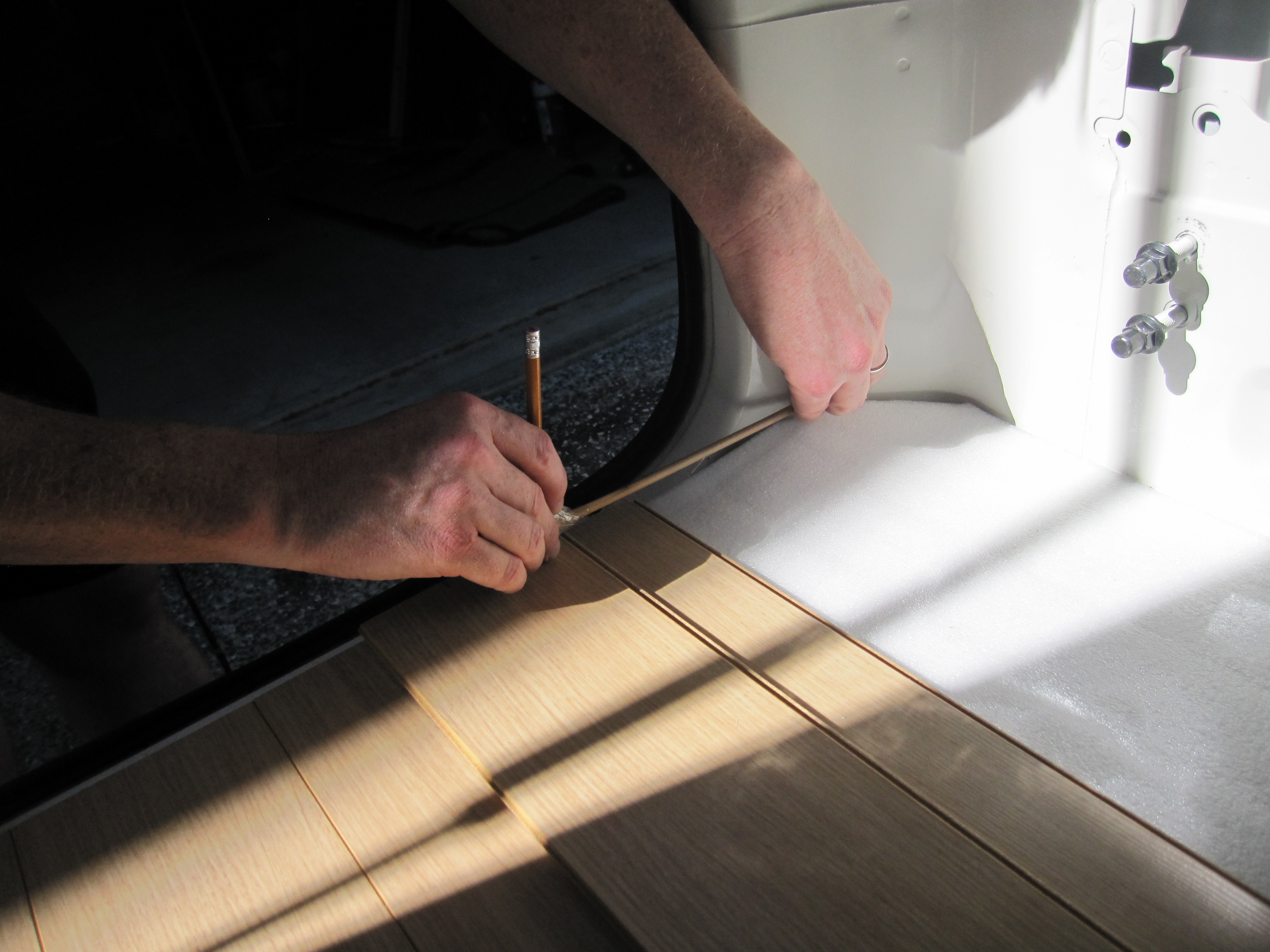
The only colour and material we had definitely decided on last week was for the flooring – after eliminating about 16 pale wood-effect laminates from our kitchen shop samples, we finally chose a really good one. Of course, we then went to Bunnings to buy it and they only had a choice of 3, all of which seemed quite different. Anyway, the palest was on special offer (it was also the thinnest – anything to increase our head height!) so we bought 60 kg of it and Paul made a start yesterday morning. Overall it was fairly straightforward. There’s a layer of insulation on the bottom, then hardboard, then another layer of insulation (all to reduce the noise) and the laminate goes on top, the planks locking together. The difficult bits were cutting around the wheel arches and the gear box at the front, which resulted in a completely blunt jigsaw blade at the end of the day, but it looks great now it’s finished.

Also, this is Paul’s ingenious new tool to draw the curved shape on the wood. Are you reading this, Dragons? Theo – surely a winner in the retail market?

Decisions, decisions – a guide to campervan interior design

I am starting to have concerns about my project manager’s taste in interior design. We’d always planned to keep the colours inside the campervan quite calm and neutral – white tops, chocolate seating and splashes of coffee or beige if we were feeling adventurous. But Paul has recently expressed an interest in a fairly alarming combination of sunbeam yellow and peacock blue. Clearly the campervan’s not large enough to accommodate nicely spaced feature walls, so I fear this could be a little overbearing. Maybe a bit too cheerful. I have to say though, choosing exact colours is quite a tricky business. The ceiling and very tops of the interior sides are covered in an attractive grey carpet, which has to stay, but we still need to choose colours for the bathroom wall, cabinets, work surfaces and floors.

Last weekend, we spent a morning trawling round a few kitchen showrooms to get an idea of different materials and colours. I LOVE kitchen showrooms and before I knew it, I heard myself explaining to the sales lady (or ‘hostess’ as she was called) that we were renovating our kitchen and how much are these lovely white stone cabinets with self-closing drawers and glass mosaic tiles? That was all very nice, but it made it a bit awkward to then try and steer round to the racks of cheap laminate samples to get a more realistic idea for the campervan. Sadly our budget and weight limit in the van preclude anything with granite or stone in the name, but at least there’s a massive choice available. We finally left two hours later with a handbag full of samples and a $20,000 quote for our own kitchen (maybe next year).

Back home, we narrowed it down to these, and spent the afternoon lining them up inside the van:

So it’s a fairly neutral and calming colour palette (like we’d planned), but maybe just a little… dull. We both like the idea of including something a bit bolder and brighter, something that will make you smile when you open the door. After all, that’s the whole idea of taking off in a campervan. So Paul’s started experimenting with different colours using Google’s SketchUp (a great program where we’ve got a 3-D model of the campervan), and it does seem to suit something more exuberant. Perhaps not quite as exuberant as peacocks and sunbeams, but some glossy red or (the ubiquitous) aqua could make an appearance. So the jury’s still out on that one for the moment. We have, however, chosen the floor – update in the next post!

Plan of attack – 11 simple steps to achieving your diy campervan

Right. These are the 11 simple steps needed to transform our maxi-taxi into a campervan so our 4-wheel adventures can take off in relative comfort. And style, obviously.

    1. Buy and fit laminate flooring. Involves removing upright bolts in floor that were used to secure the seats (and which I keep treading on), fitting chipboard, laying the underfloor insulation and then fitting the laminate on top. Having spent only 20 minutes in sauna-like conditions measuring up the van yesterday, we’re going to skip the underfloor heating at this stage.
    2. Order and fit toilet. The size of the toilet will dictate where the three surrounding ‘modesty’ screens will sit, and how much space we’ll then have for the kitchen. [note: The bathroom will also be accessible from the rear door of the van, which means we can empty the waste water from the sink and remove the cassette from the toilet. This also means we can get a bit of a through draft into the van when the door’s open. There will be a screen next to the toilet so it’s not visible through the back door, but fitting a wall next to the basin would reduce the bathroom width by about 10cm so we’ll just have a blind on the glass instead. One that’s dust-repellent, anti-static and easy to wash, of course. If such a thing exists?? (sorry, in-jokes are probably considered very poor blogging etiquette).]
    3. Order and fit fridge, freshwater tank (which will go under the kitchen sink) and waste tank (which will sit under the bathroom sink – we can then open the back door of the van and empty water from the valve at the back of the wastewater tank, just as we can remove the cassette from the toilet on the opposite side of the bathroom). Also order and fit smaller (2.5kg) gas bottle and casing, which will sit underneath the seating next to the stove.  Fitting the big ticket items early on lets us see how much space we have for everything else.
    4. Joinery – build cupboards / drawers which will go underneath the seating and underneath the stove and sink in the kitchen. And the sink in the bathroom. Also need to fit extra panel to the side of the seating which will slide out to form the bed, fit laminate onto wall between kitchen and bathroom, and incorporate the door.
    5. Order and fit water heater and water pump. Ideally these would go on the left-hand side of the van underneath the sink but that side is already heavy with both water tanks, so to distribute the weight a bit, we’ll put the water heater on the right-hand side under the stove, and run a pipe underneath the flooring to the freshwater tank.
    6. Finish bathroom – install basin, do tiling around toilet and basin.
    7. Figure out wiring and locate batteries – not sure if we’ll need one or two at this stage – but they’ll sit alongside the battery charger underneath the seating behind the driver’s seat.
    8. Electrics – fit and connect lighting, connect water heater, move speakers (currently providing piped music to the bathroom) to the middle of the van and install 3 ceiling vents.
    9. Fit work surfaces in kitchen, install sink and stove and connect to gas (will need help with this bit).
    10. Upholstery – fit seating in living area.
    11. Interior design – fit blinds and/or gingham curtains, commission surfer-chic artwork, casually scatter cushions around seating.


We’ve chosen the hottest day of the year so far to start on the flooring…

Paul resorting to desperate measures to find some shade


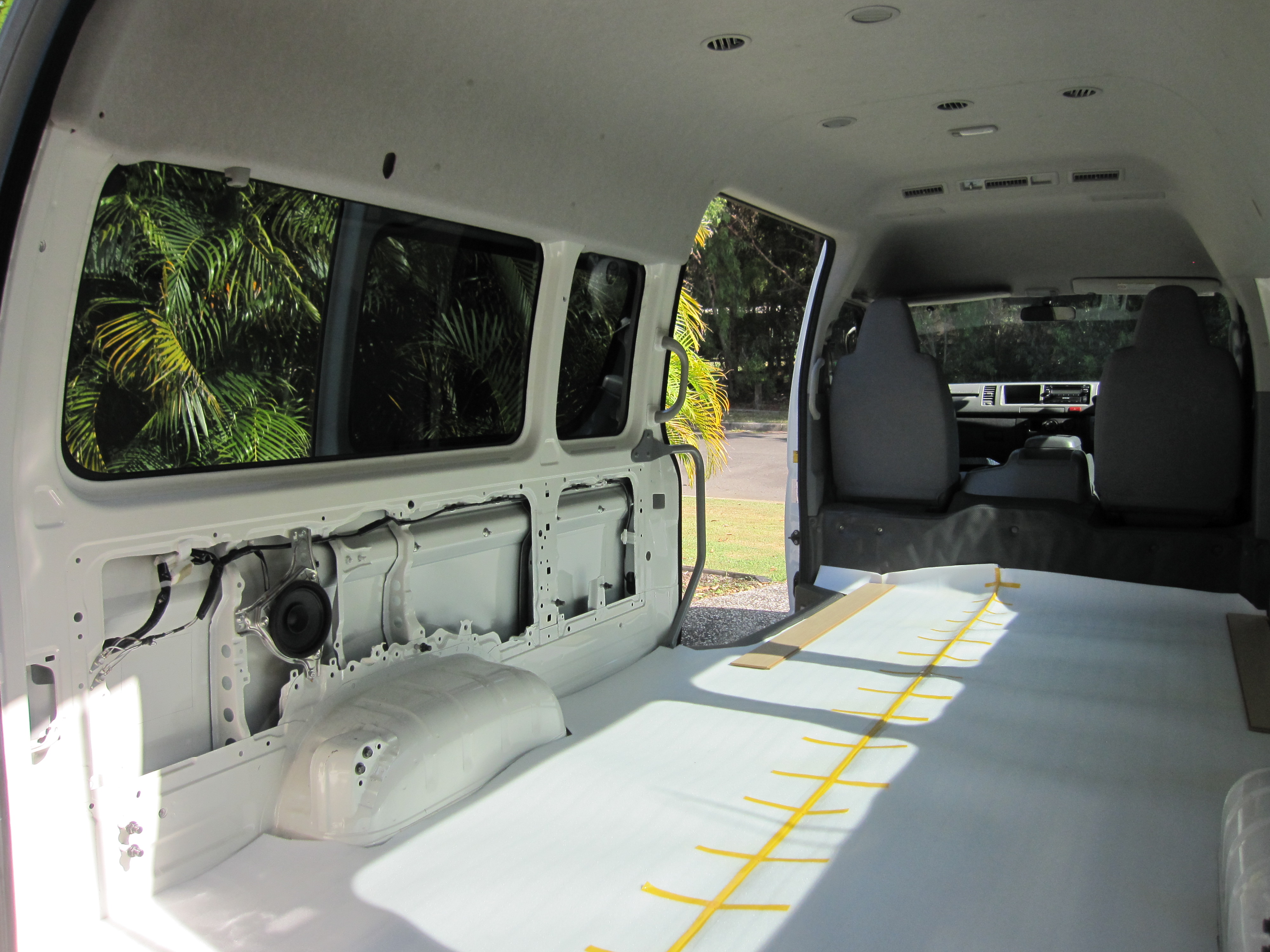
The hardboard layer and insulation went down well, and we’re ready to lay the laminate flooring next weekend. Again, let’s make it clear when I say ‘we’ – Paul is doing all the physical stuff here. I have joined in the shopping excursions, but otherwise have been taking photos from the sidelines and occasionally offering helpful advice at critical moments. Which is also an important role; we should all play to our strengths.