Wiring a campervan

Phase one of the campervan wiring is now complete – hurrah! There is finally a light at the end of the tunnel. Actually there’s not because lighting is part of phase two, but at least the fridge is whirring away nicely.

What follows is a very simplified description of how we got to this point. If you have any more detailed questions, please leave a comment at the bottom of this post!

<Disclaimer> Now, I am (clearly) not an electrician and neither, for that matter, is Paul. All the works described below are still to be certified by a licensed electrician to ensure we’re in no danger of electrocution down the track.

Okay. We have two main circuits: One that will plug into a 240v power source at a campsite, and one that is powered by a 12v battery for when we’re travelling off-piste.

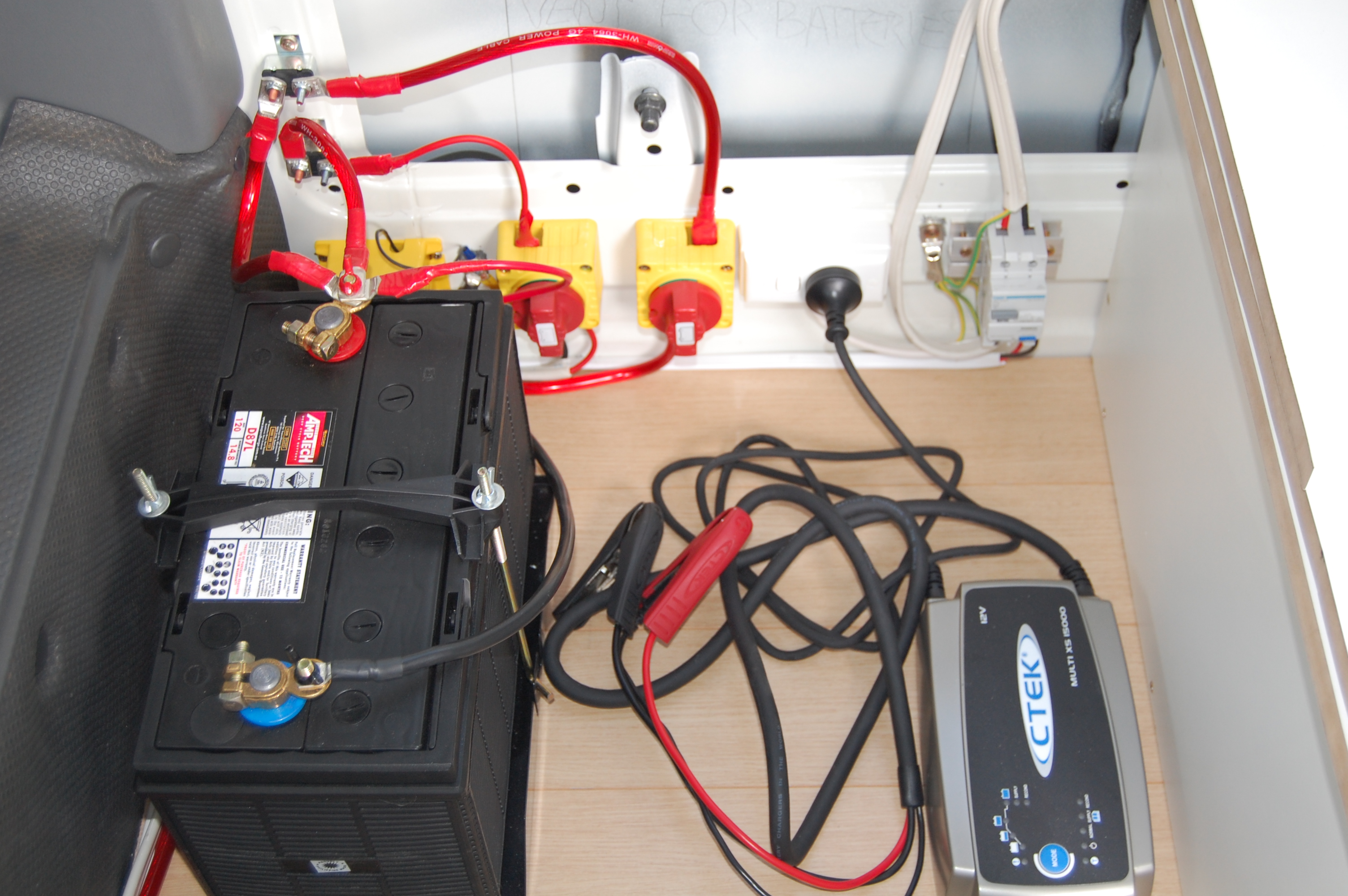
Here’s an overall view:
240v power circuit

  • Paul cut a small hole in the shell of the van and attached a 240 socket so we can run a cable to an external power supply.

  • From the other side of the socket, a 2.5mm cable runs through a conduit (to protect from any sharp metal) along the inside of the campervan to a 16 amp fuse.

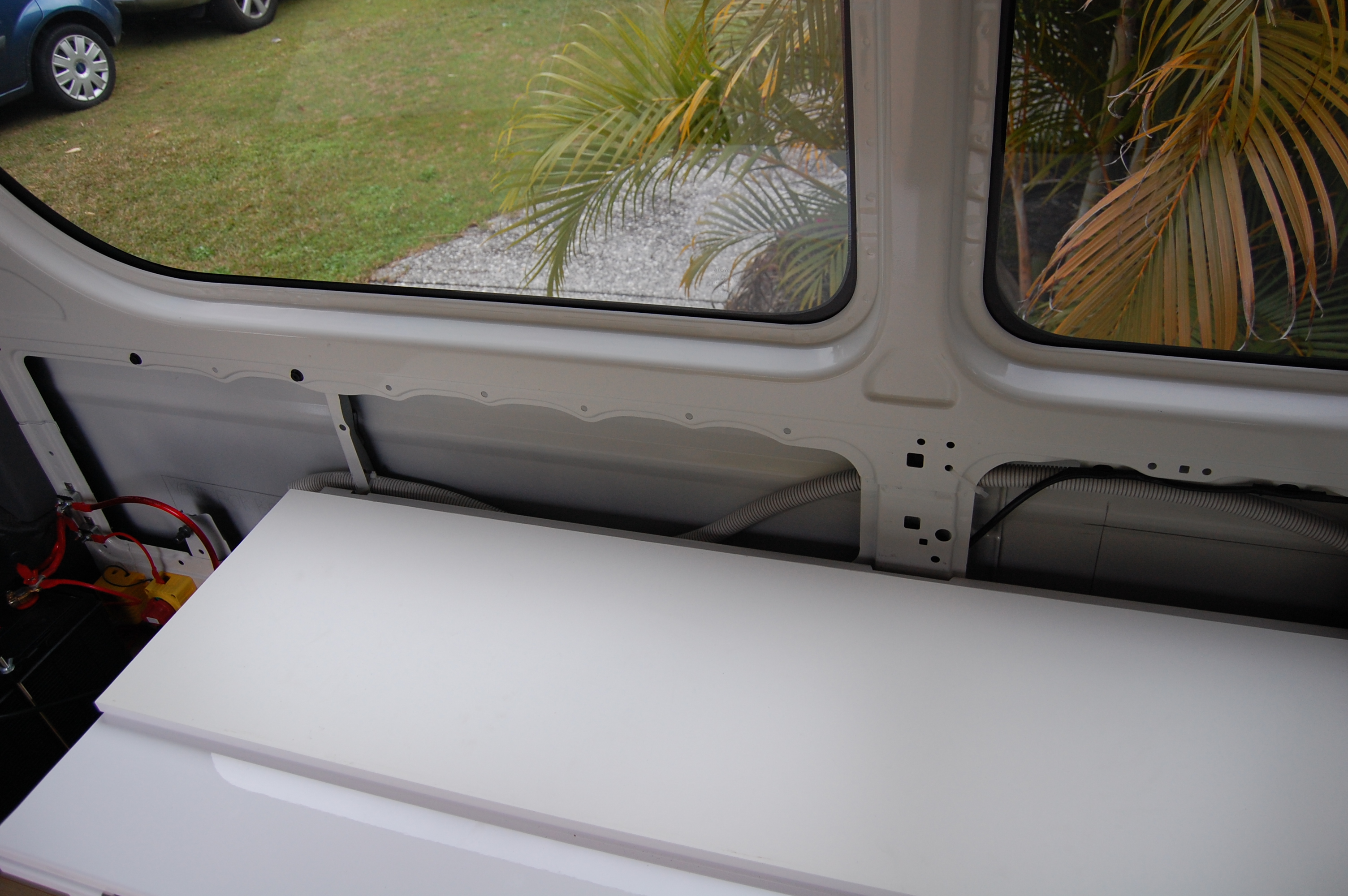
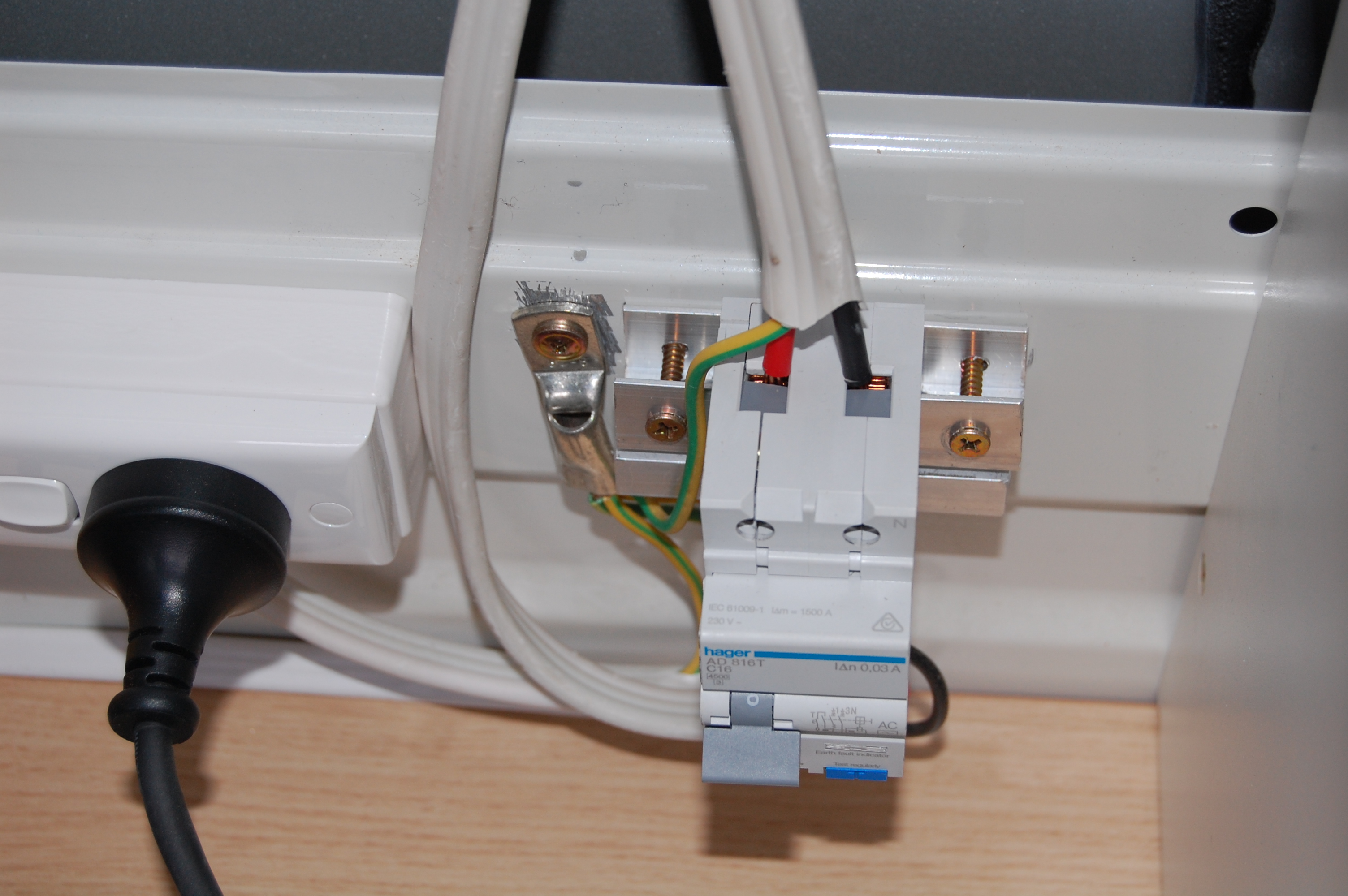
  • The fuse clips onto a small metal bracket, which is screwed to the van. The yellow and green cable shown above connects to the metal shell of the van (we had to scrape a small patch of paint off the interior) to provide the earth.
  • Three cables then run from this fuse. The first runs to a power socket for the battery charger – ours is a CTEK Multi XS 150000. The charger will eventually be hard-wired to the battery.

  • The second cable runs around the front of the living area, under the doorway (in the lower of two conduits) to the power point for the fridge.

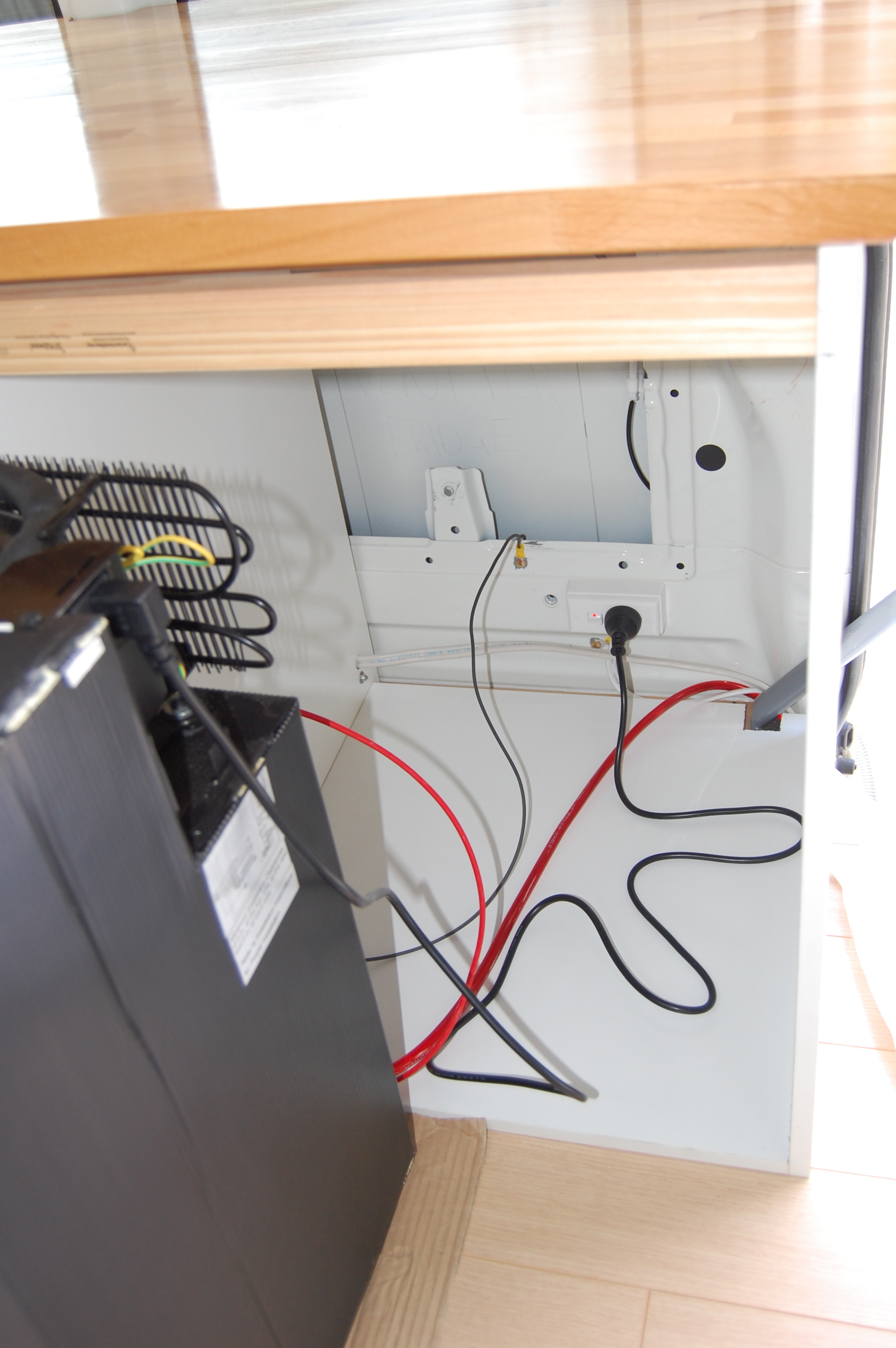
  • The third cable will run to an additional socket. Perhaps for a hair straightener.

12v battery circuit

There are two circuits from the battery.

  1. The first solely powers the fridge when we’re not connected to external power.  The fridge will automatically recognise when we disconnect from the 240v, and will switch to battery power.

The cable runs from the battery to a 15 amp fuse, then through an isolation switch, around the front of the living area, through the top conduit in the doorway and to the fridge.

We used an 8mm diameter cable to prevent any voltage drop between the battery and fridge and it seemed to do the trick; even with a 4.5m cable, we’re getting a consistent 12volts to the fridge. In fact, we seem to have gained a few…

In this case, the van’s metal shell provides the negative connection to the battery. Very handy.

2. The second battery circuit will power all other elements, which we’ll install in phase two: the water pump, lights and extractor fans.

The cable runs from the battery to a 40 amp fuse, then through an isolation switch, around the front of the living area to the control panel. Each switch in the control panel has its own fuse, ranging from 10-15 amps.
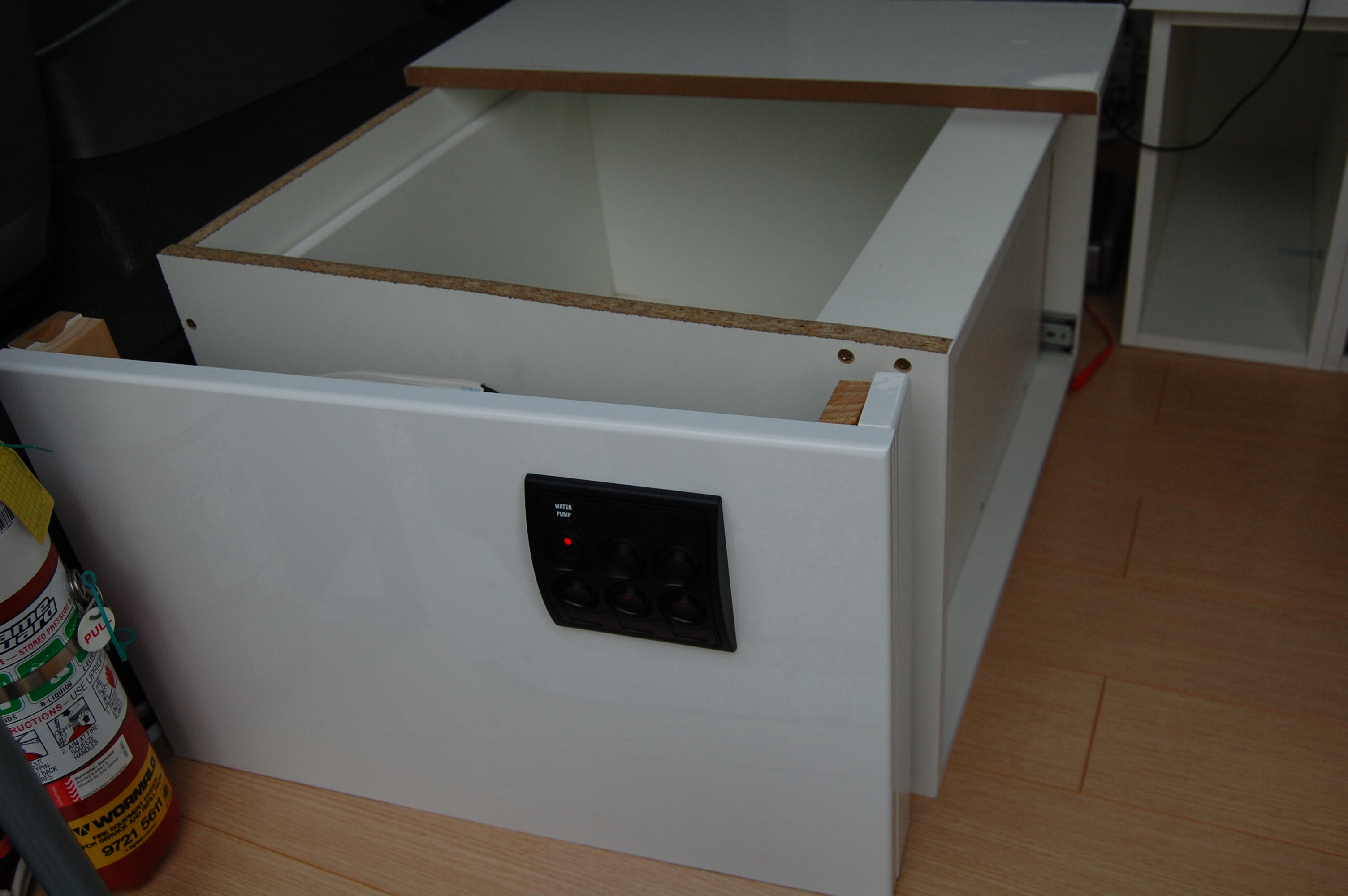
We’ll use the control panel to switch on the lights, fans and water pump. The water pump sits to the left of the fridge, so the cable runs around the fire extinguisher above, through the top conduit in the doorway and past the fridge to the pump.

Isolation switches

Running the cables through an isolation switch means we can manually switch the circuit off if necessary. We have also installed a dual-battery isolator; the car’s alternator will charge our 12v battery while we’re driving, but the isolator prevents our battery taking power from the car’s battery.
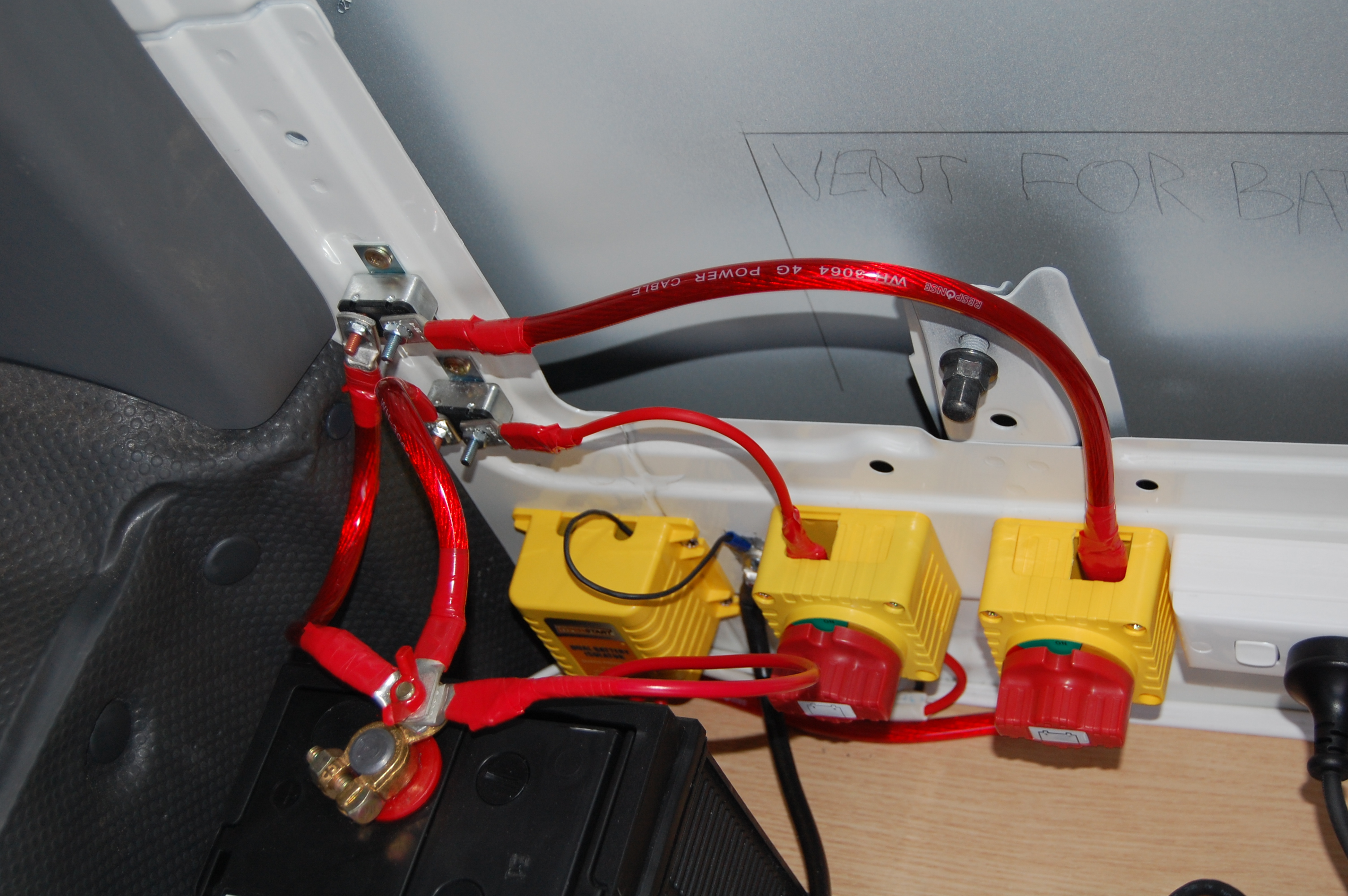
So that’s it! We bought everything from Bunnings (surprise, surprise), Supercheap Auto and a local electrical shop. Phase two is to install the lighting and fans, which involves cutting a hole in the roof, yikes.
How to convert campervan seating into a bed

After much pencil chewing and imaginary beard stroking over how to convert our campervan seating into a bed, Paul had an epiphany.

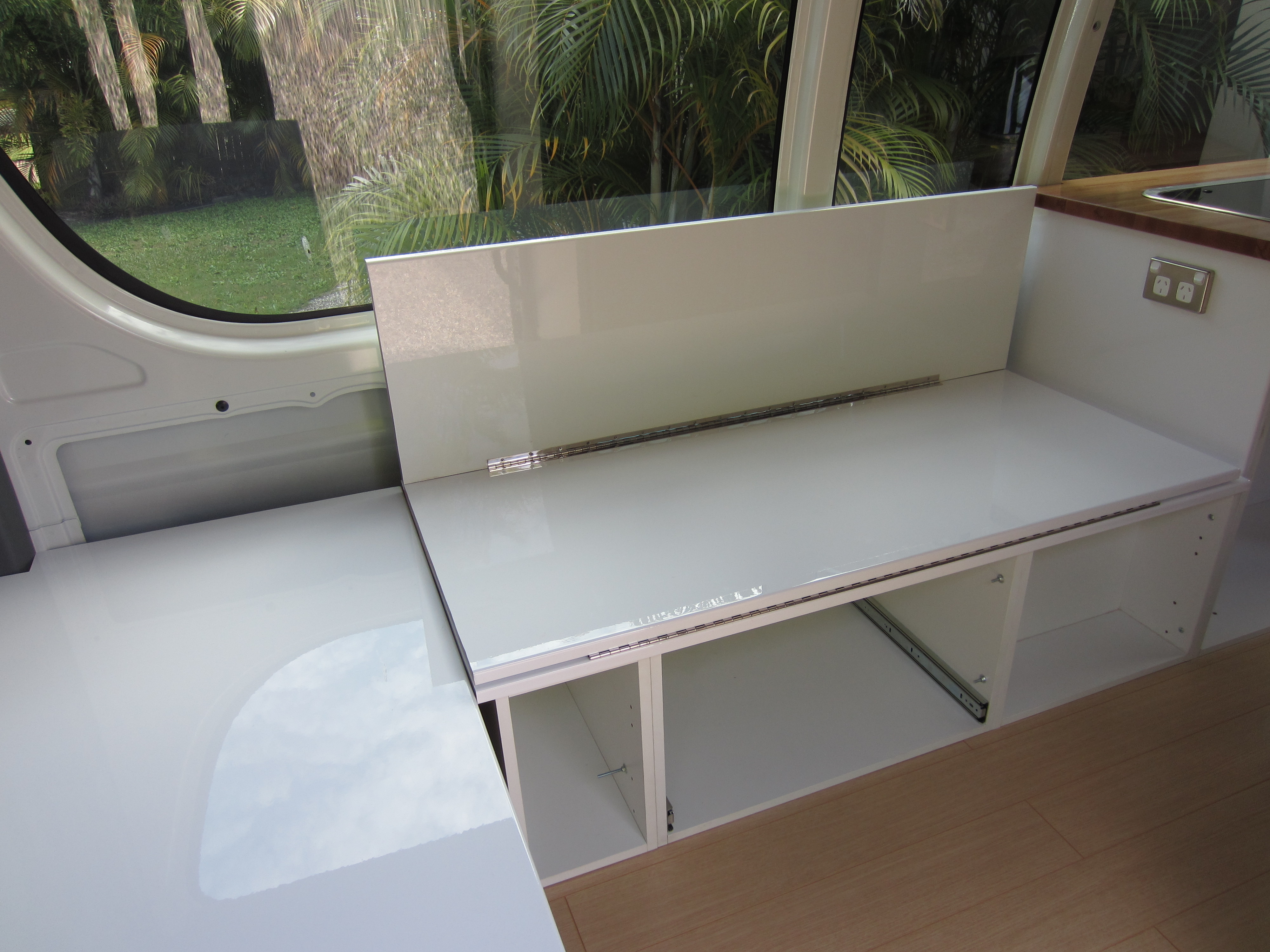
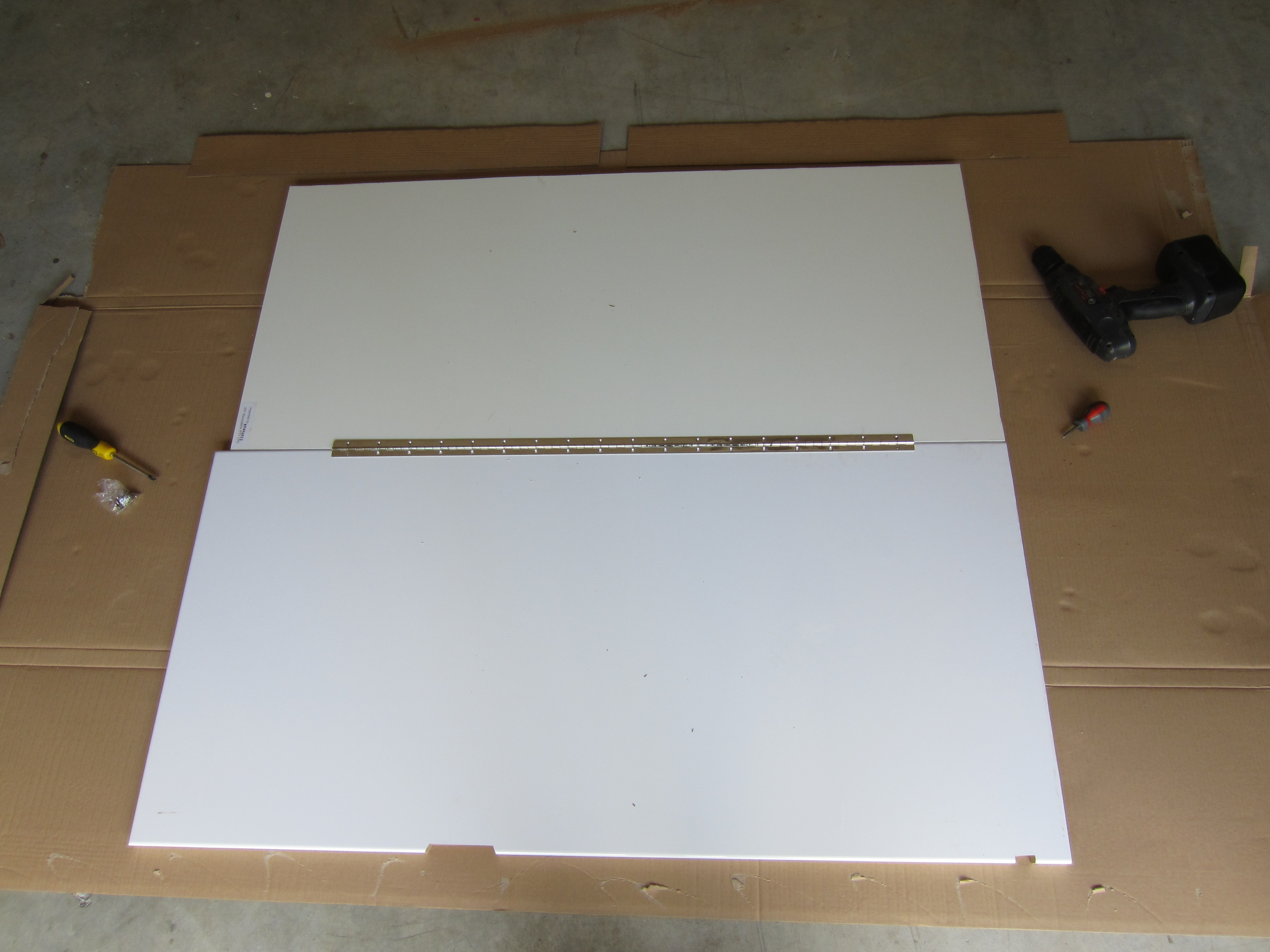
The first stage was fairly simple. By hinging an extra panel onto the long section of the L-shaped seating, we could pull it out to create the base of the bed. As shown here:


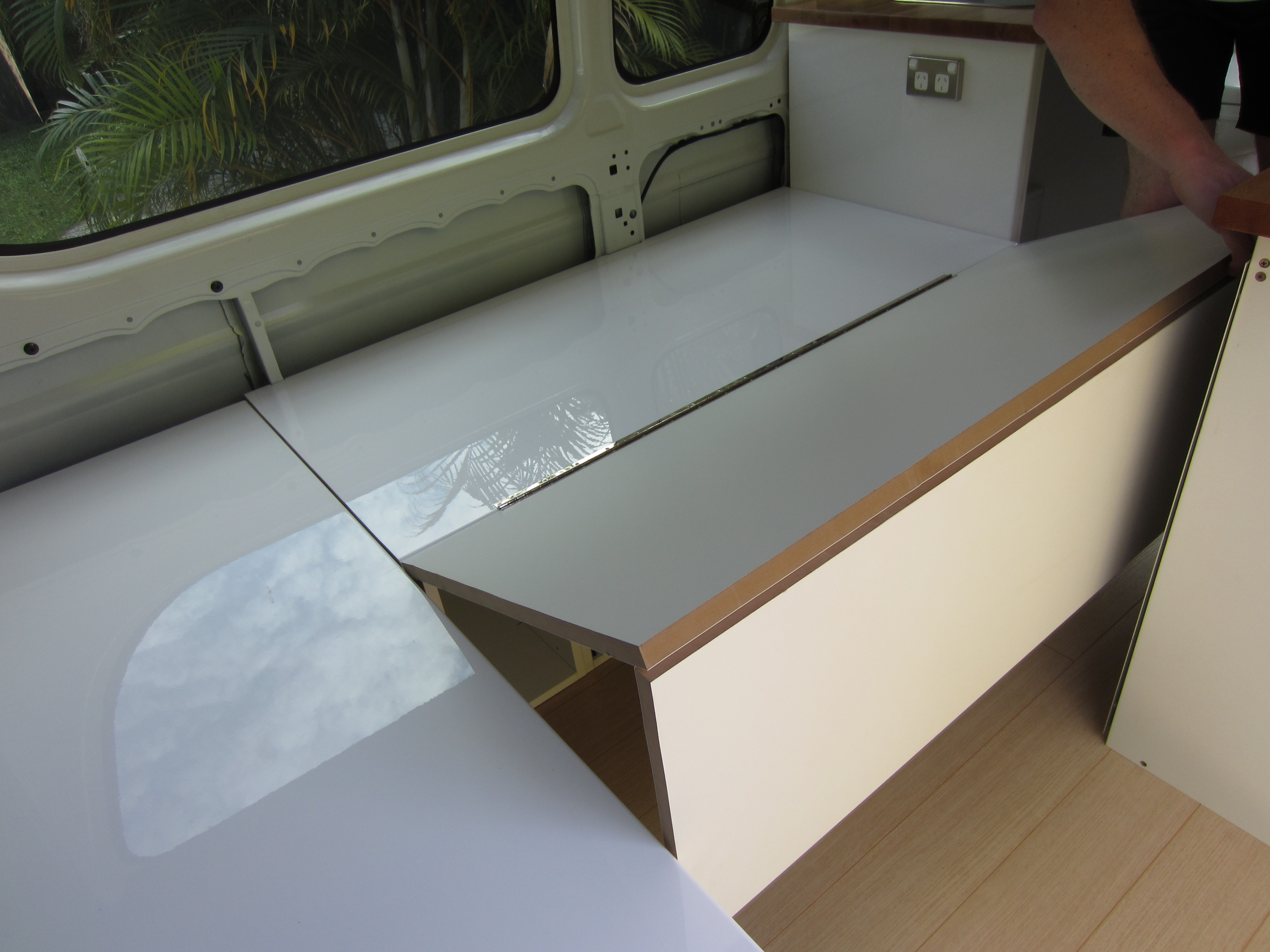
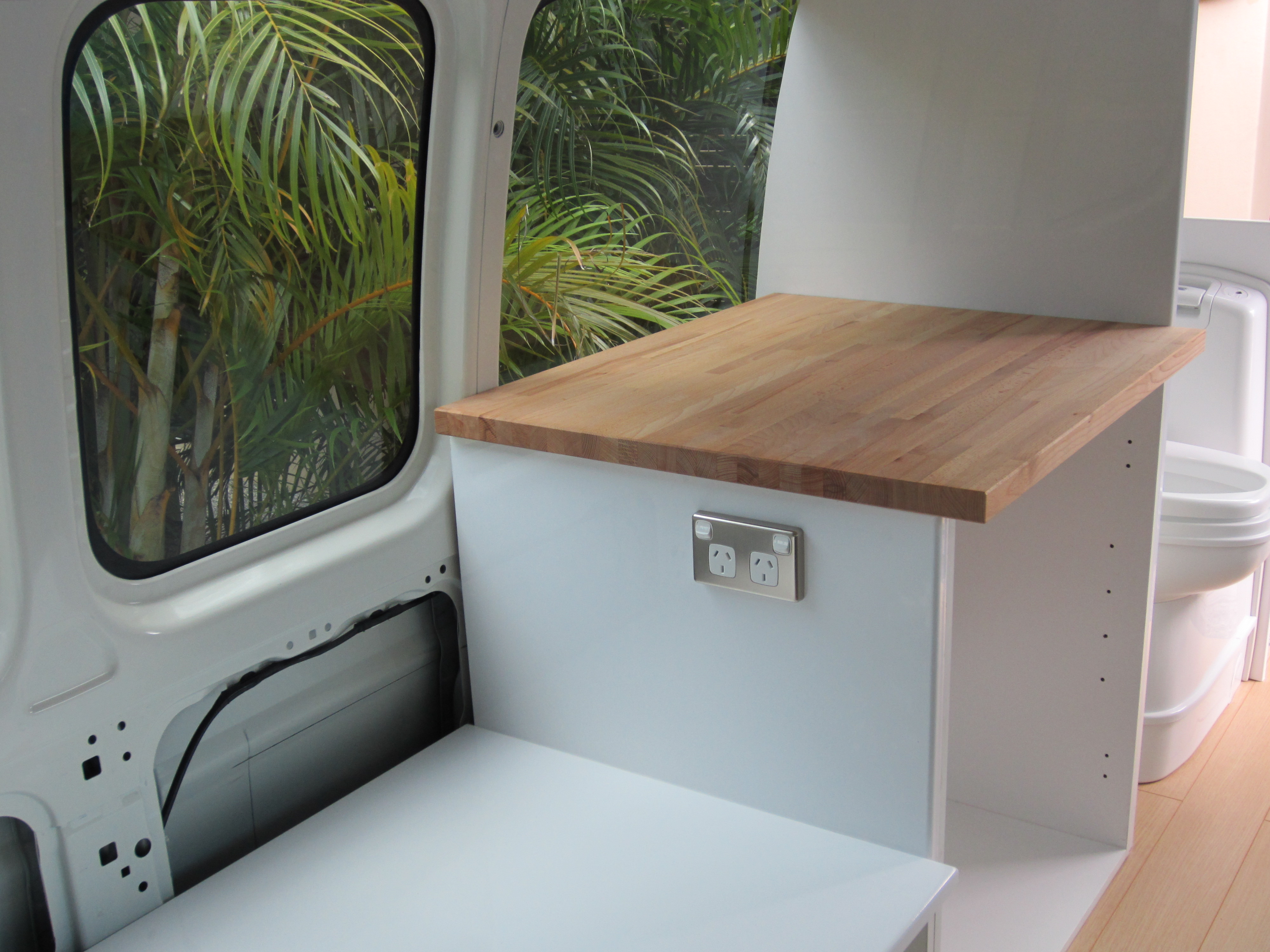
Paul had to cut the top panel marginally shorter than the bottom one, so it would clear the overhanging worksurface when pulled out. This will be hidden though once the seat cushions are on.

We’ve continued to use the same material for all the seating panels – I imagine the staff at Bunnings are somewhat intrigued by the sudden demand for their cheap pantry doors. It’s been a readily available form of MDF though with a glossy plastic coating, and has been really easy to work with.

The challenge was creating the supporting leg underneath the pull-out bed panel. The moment of revelation occurred when Paul worked out he could add another panel, which, when hinged, would act as a back rest in one position, and a supporting leg when folded down:

In the bed configuration, the two seat cushions will stay in position, and the two backrests will lie side by side on the other half. The bed is actually wider than I’d imagined; I was visualizing us both having to lie on our sides and turn over in unison, but it’s about 1.2m wide, which is fairly comfortable.

This week Paul has also fitted the master control switch, and bought the battery and the charger, so the next job is to start wiring everything up. Since winter arrived early in Brisbane, I have been lobbying for a nice warm fan heater, in case the van is finished before August. I’ve been advised to just rug up.

Confessions of a campervan convert

As a very wise lady once trilled, ‘In every job that must be done, there is an element of fun’. Well, there’s a challenge. Always keen to find, and indeed exploit, any smidgen of fun when tackling these campervan cushions, I decided to go shopping.

My shopping list:

  • High-density foam cut into two seat cushions and two seat backs
  • Wool wadding to cover the foam and soften the edges
  • Spray adhesive
  • Plenty of fabric to cover cushions and account for (ahem) unexpected hiccups along the way
  • Various reels of red cotton and random zips (mainly for practising)
  • Wine
  • Crisps (large bag)

I went to Clark Rubber for the foam, and they were excellent. The girl worked out she could save me $100 by cutting the four pieces out of a double camping mattress, which was made of the same high-density foam. So she ripped off the cover and started sawing away, while I stood and marveled at the sheer variety of interesting rubber available. Who knew!

I decided to take the spare offcuts and squeeze them into my ever-growing ‘craft box’, to join the remnants of my previous attempts at creativity. As it turned out, it was a rather fortuitous decision…

Spot the deliberate mistake. So my first job will be to do my own sawing and sticking to cobble together the missing corner from the offcuts.

Paul and I then went to Spotlight to buy the stripy fabric. I realised when we got there I should have worked out in advance exactly how much material I would need. (In my defence, I was still hoping something even more suitably surfer-chic would jump out at us at the 11th hour. It didn’t. So stripes it is.)

I had the dimensions of the four cushions, and the length of the fabric was 1.2m. That was a shame because the cushions are 1.27m long, so what I’d hoped would be the length would now be the width. Okay, so the area would just be length x width x depth. Hmmm no, that would be the volume. This was all getting trickier than I thought. I tried adding the depth to the length twice and multiplying by the width, but then what about the other ends? And what about the hems and the seam allowance that I keep reading about?

I was feeling a bit flustered by this stage. I could sense Paul was getting one of his ‘heads’ and I was starting to see various formulas flying futilely in front of my eyes: ‘Πr²’? Nope.  ‘The square of the hypotenuse…’? I hope not, I can’t even remember how that one ends. Surely it should not. Be. This. Hard. In my mind I could see my Mum (who is a mathematician – not to be confused, as I unfathomably did many years ago, with a magician – maybe that’s where I’ve been going wrong) screwing her face up in frustration. How on earth did I scrape an A in GCSE maths? I could feel beads of sweat prickling across my forehead and was on the verge of leaving the store altogether, when Paul triumphantly declared it was around 10m. Hurrah! Whether he had actually worked it out or had just seen that was how much was left on the roll, I wasn’t going to argue. So we got the lot. I’m sure the extra swathes of fabric will come in handy for something.

Overall, it was quite a successful shopping expedition, although the only items on my list that have actually been put to any use thus far are the wine and crisps. And for the time being, the element of ‘fun’ remains elusive; maybe I need to hold a little tea party on the ceiling or something, try a spot of sewing up there.

Creating a campervan kitchen

I’ve had a polite request for more campervan photos, so here’s a pictorial update on the kitchen (with as few words as I can muster!)

So our exciting delivery from Caravans Plus last week revealed a ceiling fan, a gas stove and a kitchen sink:

Caravans Plus has been a very useful supplier, we also bought the Thetford toilet and gas bottle casing there. And although they’re based in NSW, the delivery charge for everything in this picture was only about $30.

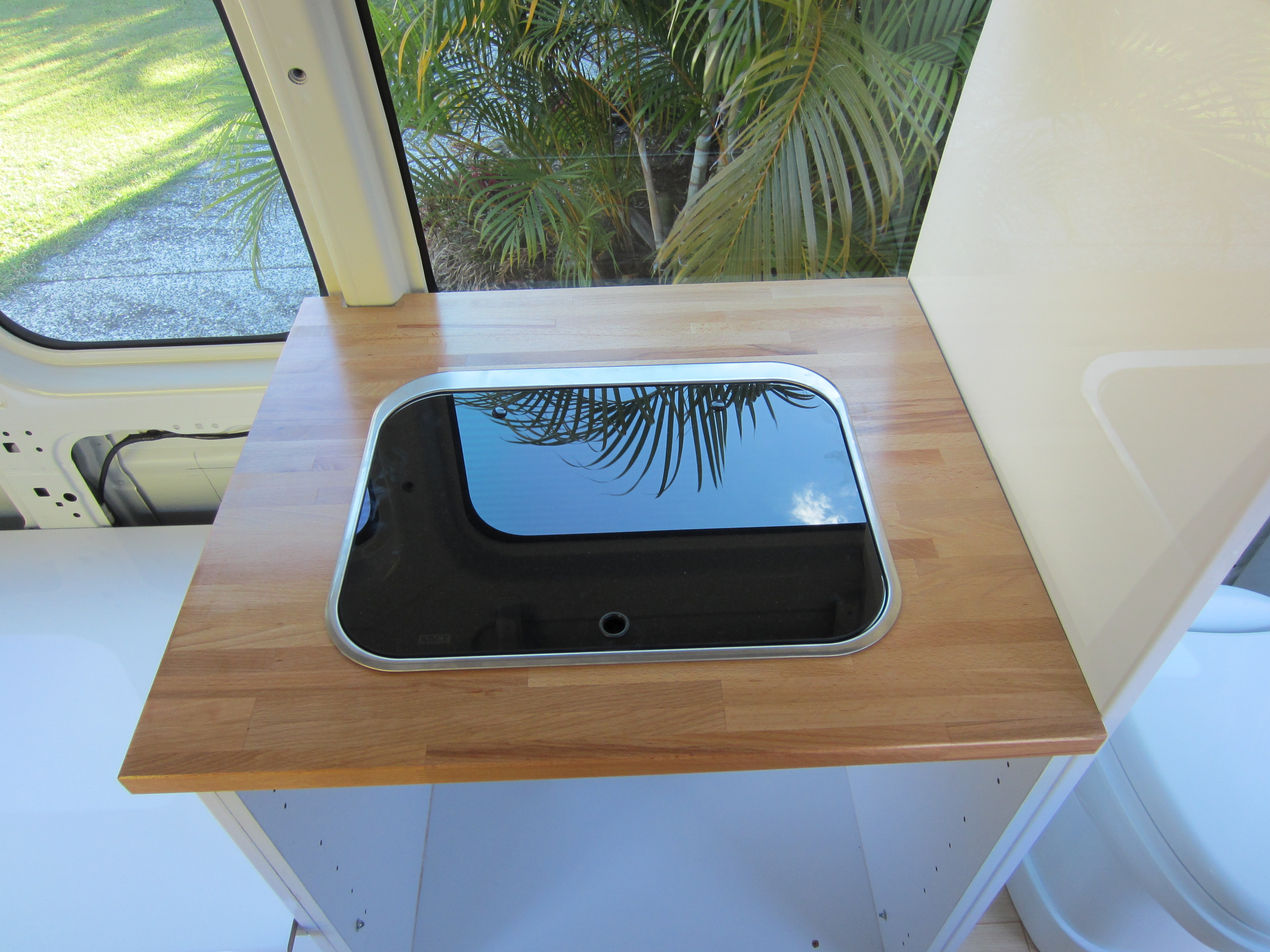
In preparation for installing the stove and sink, Paul came home every evening last week and lovingly sanded and oiled the wooden worksurface. Then he sanded it again with a finer sandpaper, oiled it again, sanded it again and gave it a final coat of oil for good measure. And then he cut a huge great hole in the middle to fit the gas stove. Still, the rim of the worksurface looks lovely and smooth:

The lid also comes down to create an extra worksurface:


It was obviously a cloudy day in Brisbane.

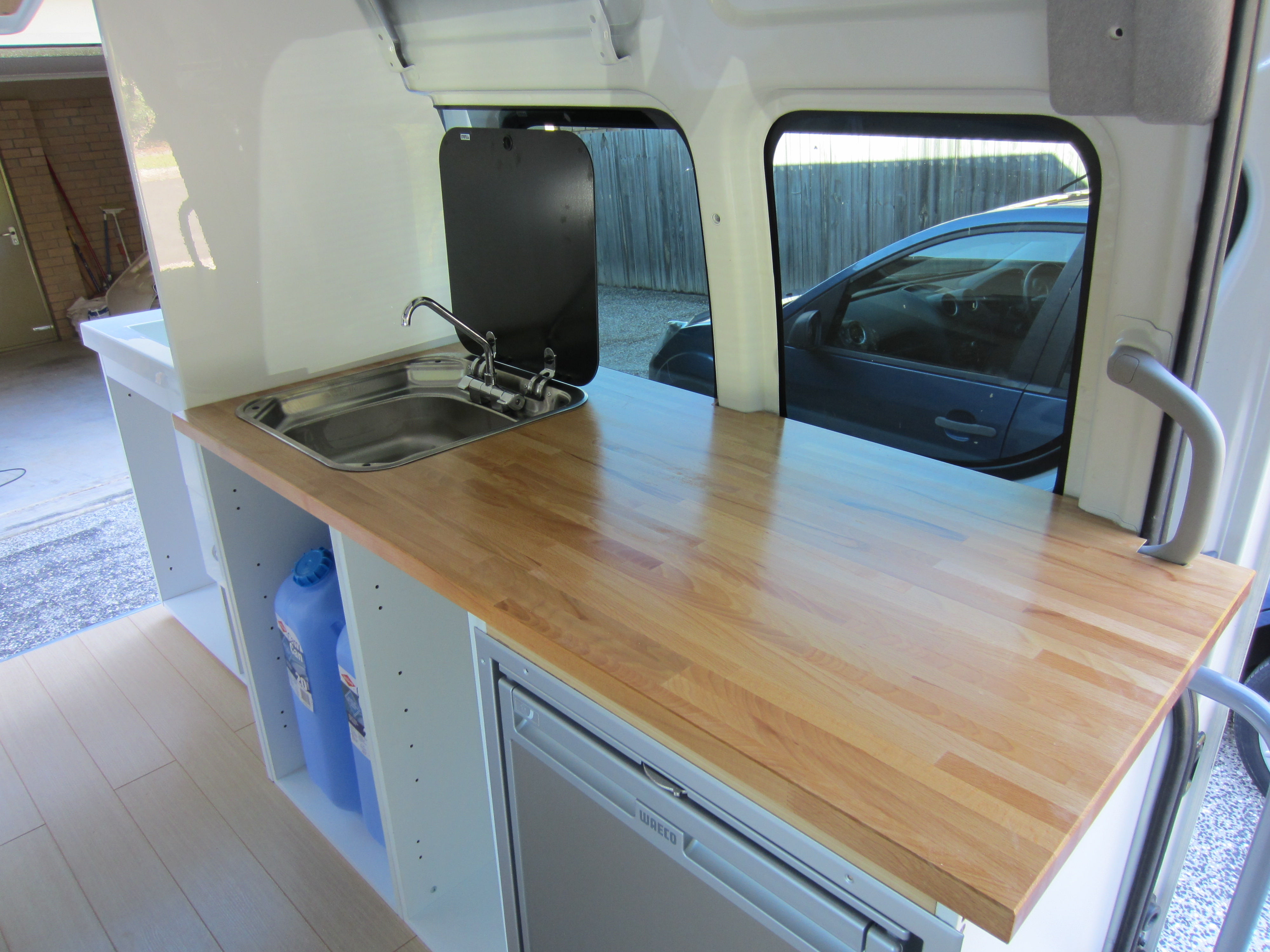
Paul also prepared the worksurface on the other side of the kitchen where the sink will sit. 

Neither the stove or sink are connected up to anything yet. 

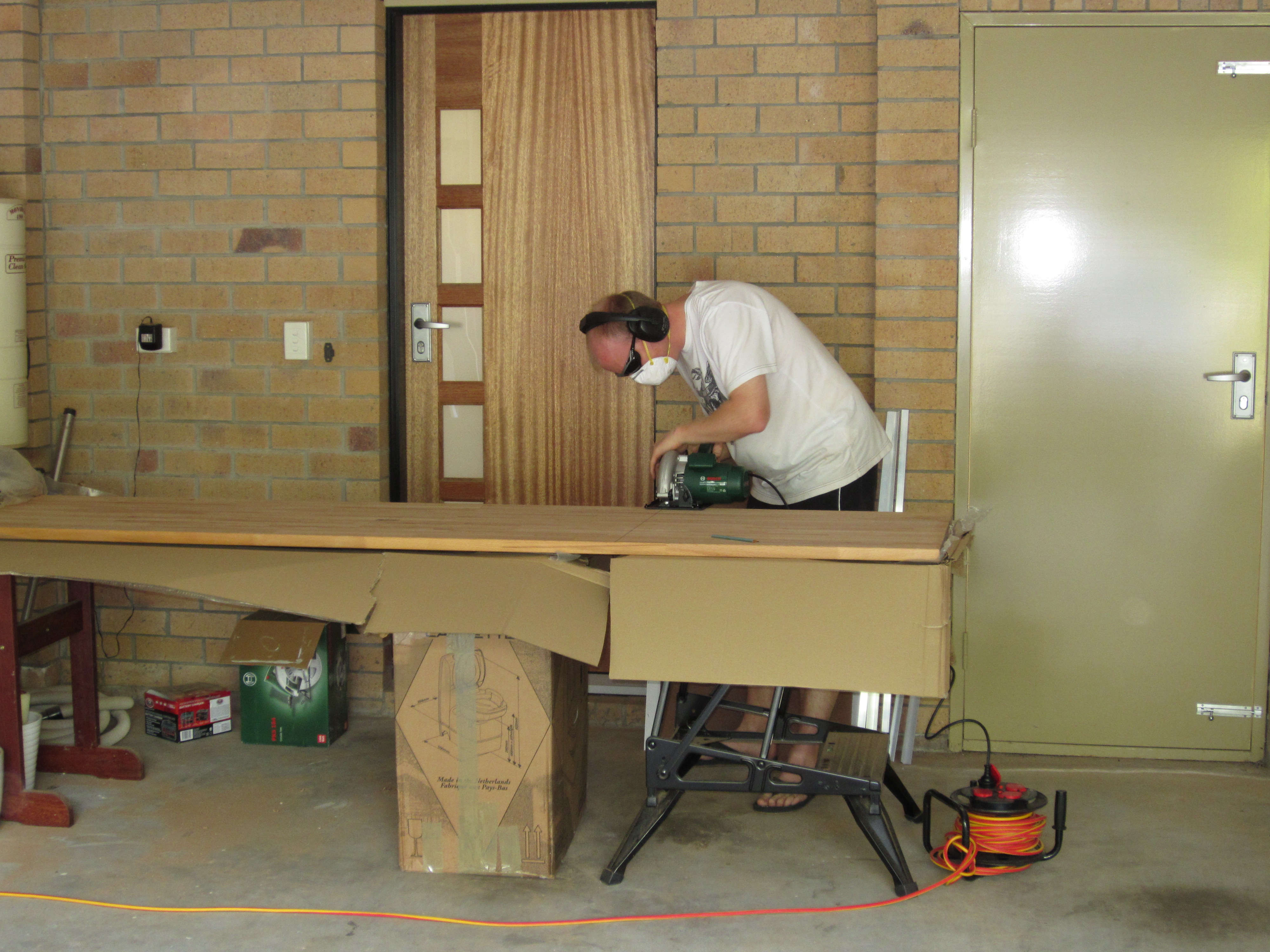
The hardest bit with the worksurface was cutting around the handle next to the door – on the right hand side of the photo above. Paul used a cardboard template to cut around the edge, and the patent-pending right-angled pencil made another appearance.

So here’s an overall view of the kitchen, I think it’s looking beautiful!

Paul has already started work on the seating / bed configuration, so that will be the next chapter in the story. Just don’t mention the seat cushions. I was distressed to discover I have inherited no sewing genes whatsoever, and combined with an innate lack of patience and defiant new sewing machine, progress has been fairly slow.

The quickest route to a relaxing weekend?

Straight down the Pacific Highway, of course. After a busy few weeks at work, Paul and I had been craving a quiet, relaxing time over the five-day Easter break. So I think we were both a little surprised to find ourselves not heading to the coast, but ensconced in a crowd of other frazzled couples being herded along the pathway at Ikea. A pathway from which there is no escape. No early exit strategy. Everywhere you look people are frantically searching for a little pink card that says ‘Move directly to marketplace. Do not pass go. Do not collect £200.’

Anyway, the plan was to look for a wooden work surface for the campervan kitchen. This was an about turn really; we’d always been keen to avoid the traditional pine look that you see in so many pictures of converted campervans, and were planning to use a pale laminate for the kitchen surfaces instead. But Paul loves working with wood, and was concerned that the interior was starting to look too white and sterile. I am inclined to think once we introduce the red cupboard doors and stripy seat cushions it’ll be hard to see any white, but I do quite like the idea of a solid wooden surface. Like one huge chopping board. So we’re hitching a brief ride on the pine-look bandwagon and have bought an Ikea Lagan worktop. It was almost 2.5 metres long, weighed over 30kg, and only just squeezed in the car (barely leaving room for my Ikea purchase: a single fluorescent dishwashing brush, which was looking a bit forlorn at the bottom of my huge yellow bag).

Paul’s cut two pieces of wood to fit each side of the kitchen and has given it about five coats of timber oil. He chose a Danish wood oil in the hope it would get along nicely with its Swedish wooden companion.

Wood before being oiled

In other news, Paul’s been doing some finishing touches on the cupboards and has boxed in the wheel arch at the back of the main kitchen cabinet, using the same laminated wood he used for the walls.

He’s also completely secured the toilet to the floor, which I am relieved about because I find it quite a comfy place to perch while Paul’s working, and as our driveway is on a slope, I was always in slight danger of sailing off down the van. Fixing the toilet was quite tricky, we couldn’t get long enough screws to drill far enough into the floor, and the limited space in the base of the toilet made it awkward to get the drill in to screw down. So Paul went underneath the van and used long bolts to drill up through the base of the van and through the floor, and secured the bolts with nuts in the base of the toilet.

Finally, the prize for this week’s most interesting photo surely goes to:

This is the steel box that Paul has resized for the gas bottle, so it will snugly fit our 2kg gas bottle rather than the 9kg one it was intended for. A bit of hacking and a lot of sticking has saved us sending the original box all the way back to NSW.

Earlier this week we had a bumper delivery from Caravans Plus which included a stove, kitchen sink and roof fan, so Paul’s going to tackle some of those this weekend.

A final word about gingham curtains

I’m sure there are plenty of craft blogs out there and I have no intention of turning this into another one. However, at the risk of confusing everyone who arrived at this blog having Googled ‘how to fit campervan cabinets’ (and alienating everyone else) I am going to indulge in one final post about my affiliation with gingham fabric.

A few weeks ago, I bought some beautiful red gingham material, which would be perfect for the quintessential campervan curtain.  Since then, I have been looking, unsuccessfully, for some upholstery fabric to match.  The stripy fabric that Paul’s so keen to use for the seat covers would clash horribly. Plain red fabric would work well with the gingham, but next to all the red cupboards might create an ambience more ‘brothelesque’ than would be desireable.  So I have reluctantly admitted defeat. There will be no gingham in this campervan. We have bought the bright stripy fabric for the seats and I am now on the search for a plainer fabric for the curtains.

So this picture is a double-edged sword. On one hand, it means I finally managed to thread the bobbin on my new sewing machine and produce something resembling a tissue case. Hurrah! On the other hand, it means that my beautiful gingham, which had so much potential, is destined to spend the remainder of its days protecting packs of Kleenex.

So put your orders in now while my bobbin is still in place. I have samples of gingham fabric in red, lilac, navy, black and lime green. How I ever thought lime green curtains would match red cupboards, I’m not sure.

Another day, another trip to Bunnings

This morning, like most Sunday mornings this year, started with a trip to Bunnings. Indeed, Paul even leapt out of bed saying, ‘Got to get up, got to get to Bunnings’, with the sort of enthusiasm usually reserved for those days when you’re hoping to find an overflowing stocking at the end of your bed.

For people reading this blog overseas, Bunnings Warehouse is a chain of massive DIY stores. They have a sausage sizzle at the entrance and a cheery lady in an apron who welcomes you in. Paul visits at least twice every weekend. And not just because he doesn’t get fed at home (he doesn’t always have a sausage) but because he usually gets sidetracked and forgets something, so has to go back.

Although I probably don’t approach a trip to Bunnings with quite the same vigour, I still tag along every couple of weeks. Last time I spent the time wandering the length of the aisles trying to work out how many products they must stock. A serendipitous visit to their website later revealed the answer – it’s over 45,000. So there you go – it’s very big, and if you’re into DIY, it sells absolutely everything you could want. I am not into DIY, and still usually end up with an armful of treasures I didn’t realise I needed.  The trouble is, Bunnings uses the same technique as Ikea and places all the intriguing and bargainous bits at the end of the aisles. You know this is a cunning marketing trick. You know that you don’t really need another miniature torch for your handbag or any more self-cleaning eco mops, but somehow, they find their way into your basket.

Anyway, there was a point to this post, which is that so far, we have bought almost everything we’ve needed for the campervan from Bunnings. Along with three torches, this has included:

All the cabinets

Laminate flooring and insulation

Bathroom sink

Waste water and fresh water tanks

Panels for bathroom walls (sold as pantry doors)

3,000 jigsaw blades

Initially we thought we’d have to get most bits from independent suppliers and caravan stockists, but they’ve been much cheaper and more readily available from Bunnings. We’ll still have to buy the specific electrical parts from a camping store, as well as things like the water heater, but if anyone is approaching a similar project, try a DIY store first before spending a fortune at other places.

Having spent the morning extolling the virtues of Bunnings, I think I will email them now in case they would like to sponsor my site.

Campervan layout – a feat of architectural design?

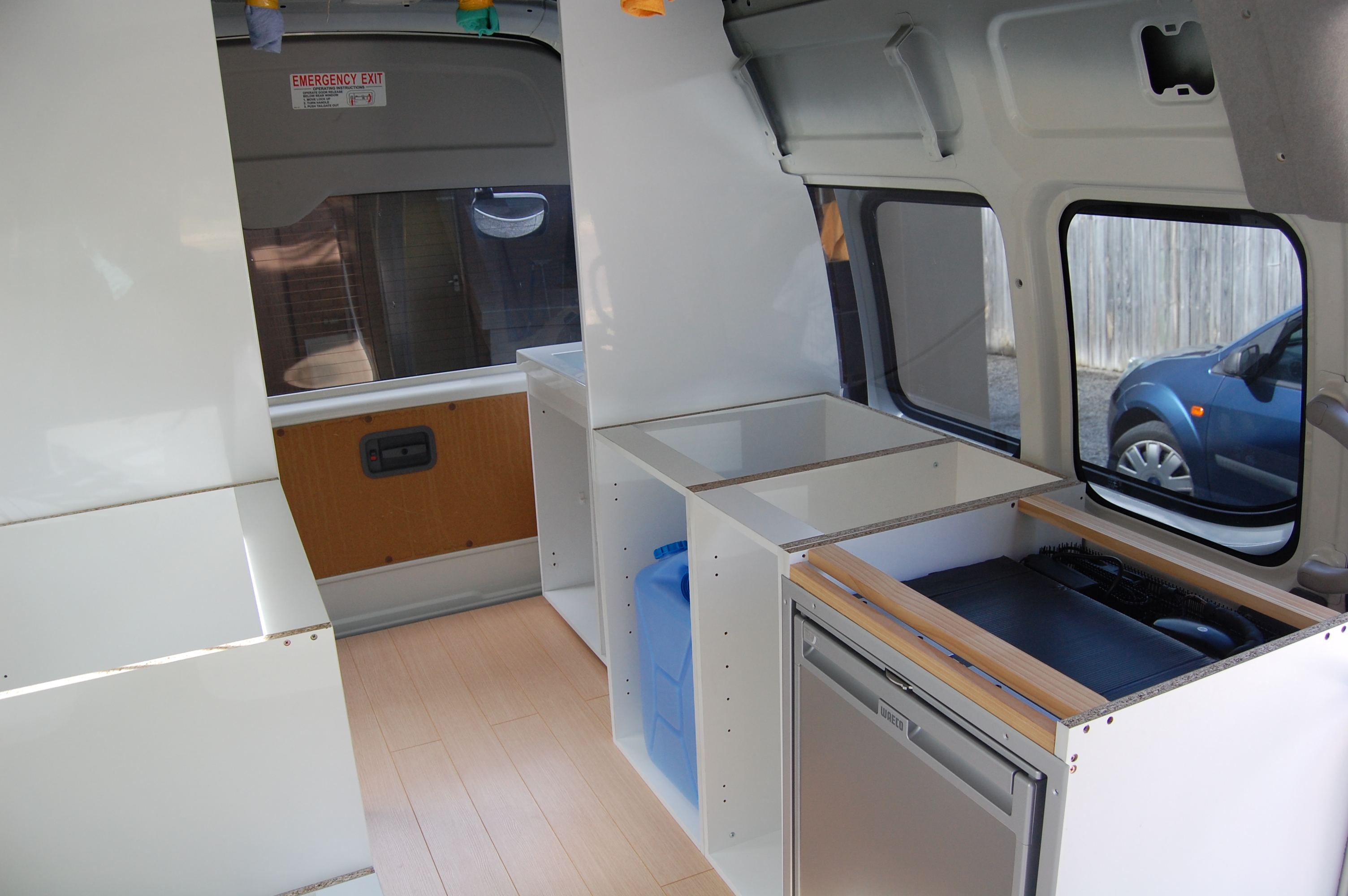
Before we started work on the van and it was still an empty shell, it was hard to imagine we’d be able to squeeze in a kitchen, bathroom and living room without it all looking very cramped. Yet somehow, now the furniture is in and the walls are up, it’s like our little minibus was always destined to be a cosy campervan. Everything just fits. It is compact and bijou! Clearly all those Thursday nights we’ve spent watching seven series of Grand Designs have been worth it – Kevin would be proud! (Actually, Kevin would say it could have been even better if we’d employed an architect, but never mind.)


The internal structure is quite defined now, and the walls have gone up between the bathroom and kitchen. Paul bought these as pantry doors and used a cardboard template to cut them to shape around the side of the van. The bathroom door will be a bit trickier. Ideally we’d want a rectangular panel that slides across the gap, but the position of the wheel arches on either side means it could only open half way. So the options are to fit a double door that opens into the bathroom, or hang a few strings of beads. That one’s still on the drawing board.


The toilet and bathroom basin are now bolted down, and the back of the toilet is fixed to another panel to facilitate the rear-entry swivel benefits, as shown below.


The seating is coming along, and the next stage will be to construct and fit an extra horizontal panel that will hinge out to form a bed. This has been a more contentious issue than you would probably imagine, and the subject of many robust discussions between Paul and his various campervan advisers. Whichever method he chooses, it’ll be one of the next jobs.

A lot of the work coming up will be less visible and includes the wiring and electrics. My sewing machine has now arrived and I may attempt another place mat before launching into the cushions. Thank you to everyone who has expressed a preference for a particular fabric. Surprisingly, almost everyone chose the same one.

(I suspect a conspiracy.)


Campervan upholstery (Part2)

I’m already anticipating many, many parts to this sewing saga. It’ll be like an Enid Blyton series: ‘Even more campervan upholstery’, ‘Having fun with campervan upholstery’ and a climactic ‘Choosing a professional campervan upholsterer’.

This weekend Paul came with me to Spotlight. It was a far more efficient trip and within five minutes he was standing at the cutting counter with five rolls under his arms. We got metre-long samples of a few completely different types that we could try out in the van, including the stripy deckchair fabric I’d seen last week in blue and red. Unfortunately, what had looked cool and beachy on the roll looked more NHS hospital gowny in the van. Particularly the blue one:

The red was a bit better:

Overall it’s going to need something quite bold and bright. My seats are going to make a statement!

The stripy one below will definitely make a statement. It is Paul’s current favourite:


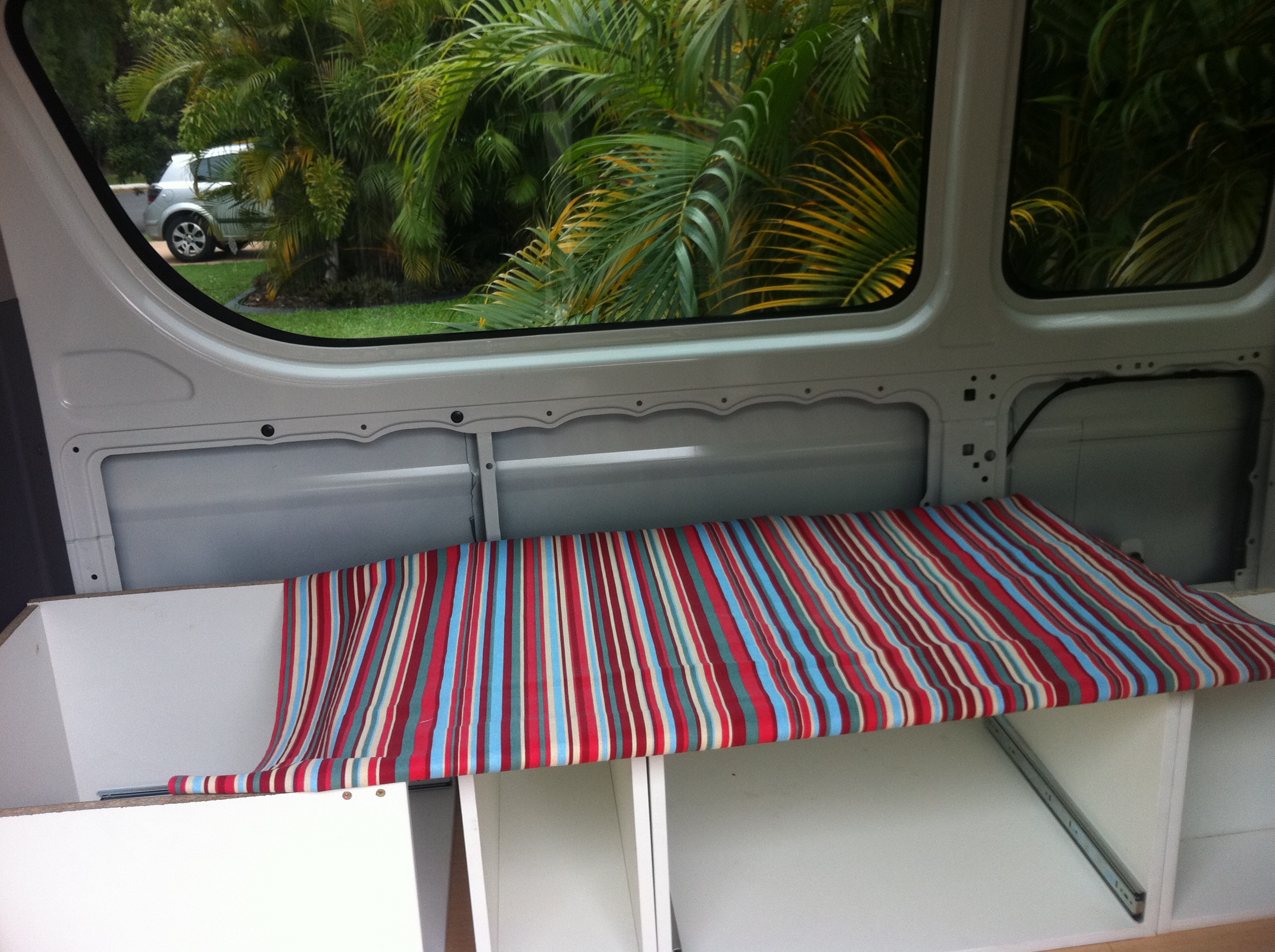
I wasn’t sure in the shop. I’m still not sure, but it did look quite good when we laid it out in the van:


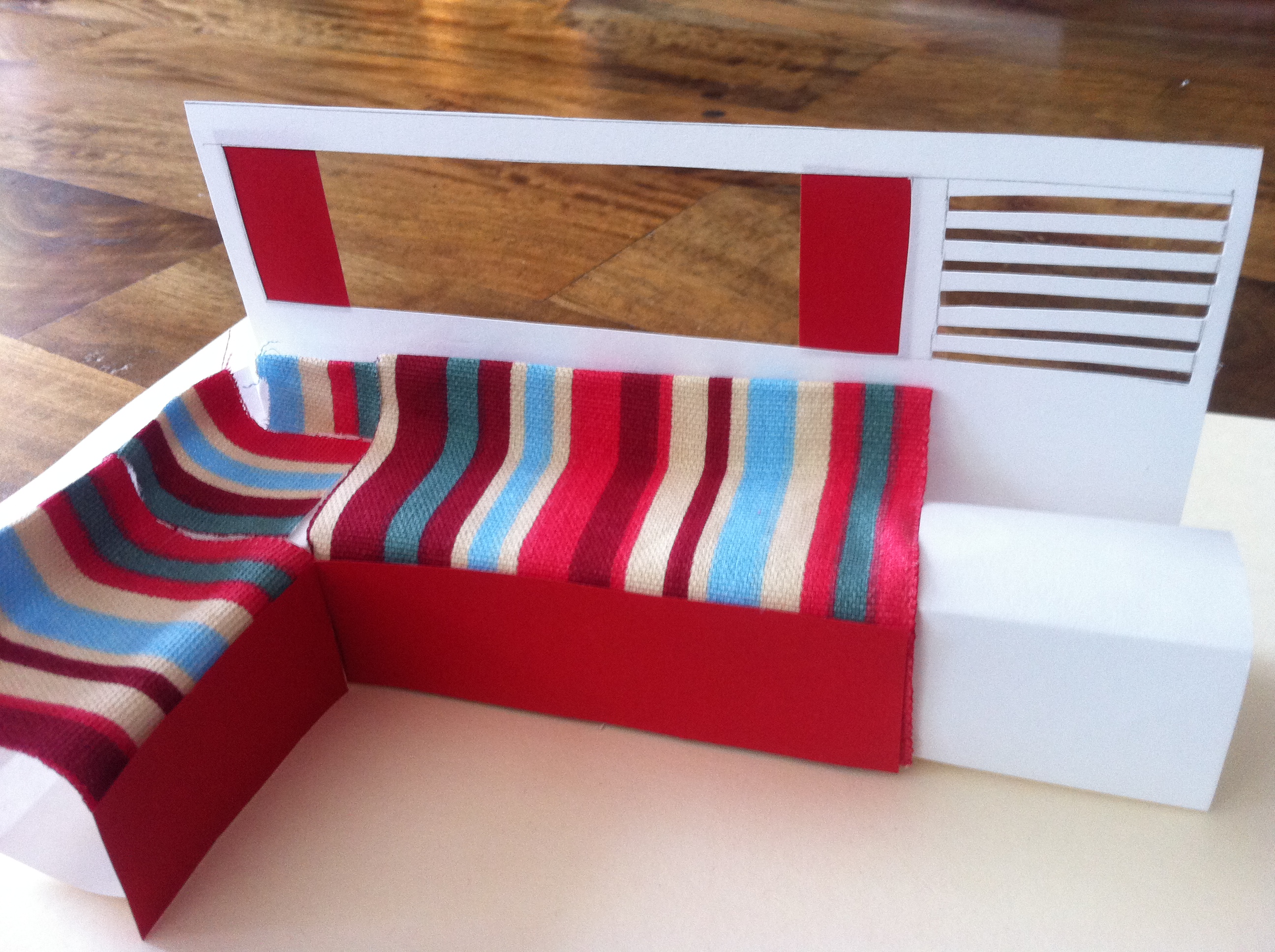
The only trouble is Paul is very keen to use gloss red cupboard doors underneath the seating, which might be too much red. It is hard to tell though when our laminate samples are two-inch squares, and I’m not keen on returning to the kitchen showroom with my extra large handbag. So yesterday I put my Art GCSE to good use and made a cardboard model of the seating arrangements. Paul likes using Google’s Sketchup but I need something a bit more tangible to visualise the finished concept. Any excuse to get out my double-sided sticky tape and… a craft knife!

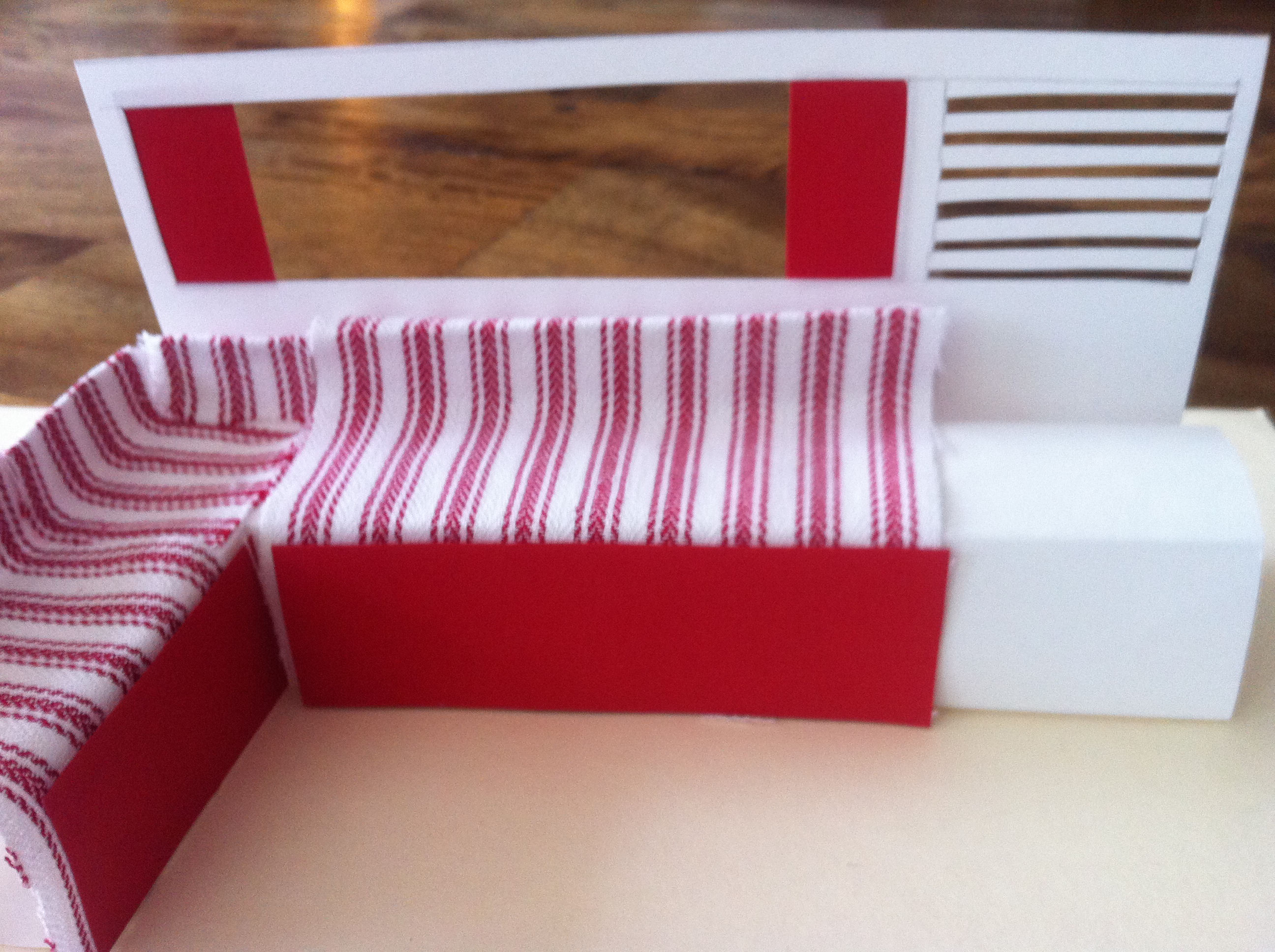
It was quite a basic model. I could sense Paul was getting a bit agitated because I hadn’t curved the window properly (i.e. at all), I’d put a worktop where the gas stove is supposed to go and ‘why are there bars on the window?’ (they were venetian blinds). Grrr. So yes, it wasn’t to scale and did keep collapsing but it was helpful to see some of the colour combinations. Here are some of the front-runners, any comments and preferences very welcome!

This is Paul’s choice. It wouldn’t look quite so overbearing in the van (I know, I know – I should have done the model to scale), but it still quite red.

I was being a bit of a cheapskate with this blue fabric, it was from the luxury selection so I thought I could get away with a free ‘finger sample’. Unfortunately the lady in the shop had very small fingers so you don’t get quite the same effect.

I quite like this one and even included Paul’s stripy fabric in the curtains for good measure, but he’s not keen on the eggshell blue.

This is quite nice, and would go well with the wooden floors. I could jazz up the curtains – maybe even do the tie-backs in the stripy fabric! Although I might be overestimating my sewing ability, I’ll get the cushions done first.

So that’s where we are with the seating. For anyone more interested in the actual construction of the campervan, I promise I’ll revert to dust and drilling in the next post, because while I’ve been dithering with fabric swatches, Paul’s been steadily making impressive progress on the interior.

The wonderful world of campervan upholstery (part1)

Other than being on hand to provide moral (and calorific) support over the last few weeks, I haven’t been physically involved with the van’s evolution so far. But now, I have a job. I’m going to be responsible for upholstering the seats.

This is quite a big responsibility as, space-wise, the seats take up a fair chunk of room in the van. They’re also very… visible. There’s no hiding them behind a screen or a gas bottle if I mess up the seams (that’s not to imply Paul is hiding anything behind the gas bottles, he’s a complete perfectionist). Anyway, I figured if he can work out how to convert a taxi into a campervan, I should be able to cobble together some cushions.

And I’m not a complete beginner when it comes to sewing; I did cross-stitch a placemat when I was at primary school in 1990 (I remember the date because that’s what I appliqued onto the mat – I’m hoping I’ve retained some of that creative imagination). Since then though, there’s been something of a sewing hiatus.

So last weekend I went to a fabric store to get the lay of the land. And a scary land it was. Aisles and aisles of different styles and colours and weights of upholstery material. One of the nice sewing ladies took pity on me as I was feverishly trying to capture each one on my phone. She seemed to be partly speaking in a different language, but the main thing I gleaned was, as long as the fabric doesn’t have a plastic backing, it’s just a matter of taste. Well that should be easy then.

This was my absolute favourite:

A sort of Cath Kidston inspired surfer-chic. Unfortunately I knew it would be vetoed as soon as I got home. It was. As was this lovely floral:

And this one:

So much for taste. I looked at some more neutral, sensible colours:

But they weren’t very inspiring. A bit too caravanny.

These were a bit brighter and quite hard-wearing, a possibility:

And I quite liked these:

A bit like deckchair fabric and nice and soft, although maybe not quite tough enough. Paul thought these could be contenders – two out of 200 is not bad I suppose.

Next weekend I’ll be brave and ask for some samples.